Saturday, February 11, 2012

Oh no you di'n't!

Recently, I've gotten in the habit of taking two little boys out on the weekends. They're nine years old, twins, and have autism. One speaks quite well and doesn't move very fast. The other speaks very little but moves like the wind, and is actually smarter than the average kid, as far as I can tell. He can outwit me, anyway, whereas I can outwit the "neurotypical" kids.

This morning, I took the fast one to watch minor hockey, because he likes it, and left the other one at home, because he doesn't. So we hung out for about two hours, ending up at the hardware store. Taking him to any store is a challenge because he will disappear, or climb up the shelves, or put something in his pocket, or who knows what else; but he was really good all morning and listening to me, so I decided to take him anyway.

Everything was going well as I followed him around the store, just watching that he didn't put something in his pocket... and then he went into the garden section, mostly by mistake, and there I saw...

SEED RACKS!!!!

The seeds are here! The seeds are here! Weeeeeeeeeeeeeeee!

I was so excited, I just about walked away from the boy to go look at them. Which might not have been a disaster, because he's actually a pretty good kid, but the whole point of me taking him out is that I'm fast enough and focused enough to keep an eye on him, thus making it possible for him to act natural instead of being constantly restrained or in trouble. So if I'm going to wander away from him, that rather defeats the purpose of me spending time with him.

So, we left the store with one toy for him and none for me.

Then I went home, had a nap, went to the library, and then I walked back to the hardware store and bought some seeds. Autistic kids and I have this in common that we don't give up easily.

Thus the first seeds of 2012, not counting the few I got by mail late last year, are pansies (Swiss giants mix) and... Atlantic Giant pumpkin. Had I stuck to catalogue orders, I might never have ordered Atlantic Giant, but unlike all previous years, the OSC display at the store had some. So now I have some.

Now the question is, what do I do with them? By my calculations, they need to be seeded around 1 April. That's... seven weeks from today. Seven weeks! Woe! I don't want to wait seven weeks!

I think I need to get another one of those nice deep planters like I have for Za 7, and plant one pumpkin seed now, and the rest later. Or maybe get eight nice deep planters, and plant one pumpkin seed a week from now until 1 April, and see what works best.

And this is how my gardening expenses grow into the hundreds of dollars, "just two bucks" at a time.

Baobab Friday

Wow. It's been cloudy for so long, I've forgotten how to take pictures in sunlight. Anyway:


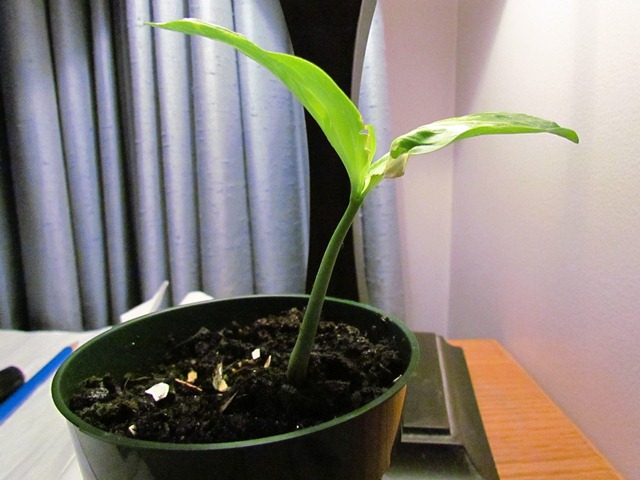
Za 7 is now 8" tall. It's the first time since sprouting that it's grown less than an inch in a week. I hope that doesn't mean the repotting went awry. It seems perfectly healthy, as far as I can tell. The spread is now 7".

The big news with Za 7 is that it has a branch! I've never seen a tree branch that fast.


Mad' 1 is now 5" tall, but still has no "spread". The seed shell is absolutely refusing to let go. I've tried, and it's quite immovable. So the baby leaves are still stuck together, but the leader is escaping off to the side. Trees are very cunning, if you let them.

Live long and prosper, little ones...

Sunday, February 5, 2012

I hate you, mold!

Mold. Is there anything it can't ruin? Is there any such thing as a good mold? What is the evolutionary purpose of mold? Other than penicillin, does mold do anybody any good?

Obviously, I have mold in my hot house sprouting kit again. Or still, I should say. I was hoping that by frequent rinsing, I could delay the mold enough to give the seeds time to sprout. Today, however, when I checked, there was green mold on A. suarenzis White mold is fine; green mold, I've never seen it on my plants before, but I'm guessing, not so much.

I decided on an extreme remedy: boiling the seeds a second time. It might kill the seeds, but it might kill the mold first. Or not.

Now one thing I know, thanks to the fact that we get a boil-water order every year in spring, is that you have to boil water for a minute to defeat the germs, so I figured, if I boil my seeds for one minute, they should be mold-free. But I didn't have a clean pot available at that moment, so I decided to microwave some water. Water can become super-heated in the microwave, so that its temperature is in fact above boiling but it hasn't undergone phase transition yet. So I figured if I just throw the seeds into super-heated water, by the time the water cools down, the mold should be dead.

As it turns out, however, I didn't microwave the water long enough. My old microwave was very powerful; the one I have now, which I rent along with the apartment, is very feeble. So not only the water wasn't super-heated, it wasn't even boiling. But since you can't tell the difference to the naked eye, I only found this out when I put the seeds in.

Crud...

The white mold was promptly removed by the hot water. The green mold wasn't. But then I noticed something else. So I drained the water and looked at the seeds, and...

two of them had actually starting to sprout.

Boohoohoohoohoo!!!! I'm so sad. Why oh why didn't I rinse them in cold water first? Then I'd have known. And A. suarenzis is one of the two, which means I didn't even really need to worry about the green mold. Two more days, we'd have been fine. And the other was the kwyjibo seed, which is really hard to sprout and had no green mold, and really didn't need this treatment at all.

How sad... I might have killed two perfectly good sproutlings.

Or, maybe not. When you think about it, the water wasn't boiling, and they weren't in it very long. Both sprouts were still white and firm to the touch after the bath. Maybe they're still alive. I put A. suarenzis in one of the pasteurized geranium pots, and kwyjibo back in its cell. Maybe they'll live after all.

If not, at least I got experience. As the saying goes, "experience is what you get when you don't get what you want." I'm getting quite a bit of experience in sprouting stubborn seeds, if nothing else.

Friday, February 3, 2012

Baobab Friday


I had to rearrange things a little to fit Za 7 under the bedside lamp. Nothing too good for a baobab, right?


Za 7 is now 7 3/4 inches tall and 6 inches wide. After drooping slightly last night, it's back in top form, as badass as ever.


Madagascariensis 1 is 3 inches tall. It doesn't really have "spread" yet, clearly. Usually I'm very impatient and knock the seed shell off as soon as I can, but that typically tears the leaves, so with the baobabs, my new strategy is to leave it until it falls on its own.

If this trend continues, Za 7 should reach 25 m tall in about 18 years. Inshallah.

Thursday, February 2, 2012

More and more curiouser

I'm trying to figure out what went wrong with Za 1 and Digitata 1, to avoid making the same mistake. Having been very careful how I watered Za 7 so far, I decided that I must have over-watered the other two, and proceeded to prove it mathematically.

At first it seemed I must be right: Digitata 1 got 4124 mL of water in 91 days, Za 1 got 3875 mL in 70 days, and Za 7 got 1575 mL in 70 days. Clearly, I was watering way too much.

Except... Za 1 and Digitata 1 were in 6" planters, and Za 7 was in a 4" planter.

Math math math math blah blah, and the moral is, Digitata 1 averaged 76 mL a month and Za 1 averaged 92 mL a month, which is normal for rainy season conditions. Za 7 has been getting 84 mL a month so far.

So my theory seems rather shaky so far. But maybe if we consider that Za 1 and Digitata 1 also got left out in the rain repeatedly, and that the soil was saturated and packed firmly before I seeded them, and that they weren't under a lamp and didn't have consistently have high temperatures... maybe it still is a question of over-watering.

Oh well. As long as Za 7 doesn't die (inshallah), I suppose it doesn't matter very much.

Stupid peat-free pellets...

Nothing else has sprouted in the hot house kit since Sunday. Which is fine. Normal, even. But what isn't so fine is that the white mold seems to be growing faster and faster. I just had to rinse them again this evening. Third time in five days.

Maybe next time I'll pasteurize my peat-free soil pellets first.

Baobab transplant committee

It came to pass on Sunday, after the emergency transplant of Madagascariensis 1, I bethought myself that trees are supposed to be about the same height above and below the surface, and Za 7 was clearly taller than its little geranium pot. Therefore, presumably, it needed repotting.

Step 1: buy pot


Here you can see the new planter on the right. Potted trees need depth more than surface area, so I got the same style that I have for the lemon trees, except smaller and a more peaceable colour. This is 8" x 8" on the surface, and 10" to the water reservoir. It's self-watering, of course, so the soil doesn't go all the way down inside.

Why is the new planter beside a bowl and a milk jug? Because I was perplexed by an optical illusion. First of all, this is my new graduated jug, the old one having sprung a leak, and I'm perplexed and annoyed that when I did the graduations, I ended up with 4.25 L instead of 4.0. Clearly, I must have under-filled the measure by 6% each time, somehow. Anyway, when you look at it this way, the bowl on the left looks bigger than the jug, and the planter looks like maybe the jug plus the bowl, right?

In reality, the bowl is 2.89 L, the jug is 4 L, and the planter is 10.5 L just for the soil part, so not counting the water reservoir. And even knowing that, and looking at them jointly and severally for a long time, I can't see it with my brain. I can only know the math.

Whatev'.


Step 2: pasteurize growing medium

This time I got smart and went looking for a meat thermometer where it might actually be found, namely, the hardware store. Heaven forbid the food store should sell cooking things, you know. Now I seem to recall that in the instructions for pasteurizing soil, it said each batch should be no more than 3 or 4 inches deep. Conveniently, the bowl pictured above, which is my biggest oven-safe dish, is 4" deep.

Great. But wait... All my reserves of soil and manure are frozen outside. I brought the manure in on Monday, same day I bought the planter, and let it thaw overnight. And I bought a $5 bag of good quality soil rather than trying to dig, thaw, weed and amend the cheap old stuff I have. Nothing too good for a baobab.

Good. Well by the time I have anything to pasteurize, it's Tuesday night, 48 hours since I resolved to do the transplant. Argh! I hate things not getting done. But I hate even more things being done badly out of haste, bad planning and stupidity, so I have to go along with the laws of thermodynamics. And with the fact that Tuesday is my Bible study night and I don't find it appropriate to forgo the work of the Lord for other pursuits. The Lord himself is very stern about respecting his Sabbaths, which is much the same. But I suppose you didn't come here for religious indoctrination.

So finally Wednesday night, I can get around to pasteurizing. I put on my Facebook status "Elise gets to bake cow dung tonight. Yay, baked cow dung!" Curiously, this got no reaction at all. Not one. Now mind you, everyone writes Facebook statuses for the purpose of getting attention, so you can't really expect your friends to react to your status too often. Still, you'd think at least one person in 66 would question why one should bake cow dung. But no, not one reaction. Have I become predictable? Or worse, have I given my Facebook friends the impression that I'm trying to be interesting, thus making them roll their eyes at my would-be witty statuses?

Existential questions indeed.

Be that as it may, I pasteurized the dung first. I filled the 2.89 L bowl. The manure was moist from being outside, but I added a couple cups of water for good measure. The role of water in pasteurizing feces is the same as in nuclear reactors: it helps moderate temperature changes. So too much is a nuisance, but too little could be a disaster. Then, I covered it with two layers of foil, stuck the meat thermometer into it, and away into the oven.

Initially, I had pre-heated my oven to 180 F, being the desired temperature of soil pasteurization. An hour later, I came to realize that dung apparently has a very high heat capacity, and it would take hours to get it up to temperature at that rate. So, I cranked it to 350 F. This solves my not wanting to be up till all hours problem, but poses the risk that the outside will get too hot before the centre gets hot enough.

In short order, therefore, the temperature got to 190 F, at which time I took it out of the oven. But, as any cook knows, hot things will keep on cooking unless you cool them down. So the temperature kept rising. I lifted the foil to let out some steam, and finally the rise stopped just short of 200 F, the temperature where allegedly, toxins will be produced. Then, very slowly, the temperature started to fall. To achieve pasteurization, I'm told I need to maintain the temperature between 180 and 200 F for half an hour. This was easy enough, as it took more than 30 minutes to cool that far; but in hindsight, maybe the outside layers cooled faster than the inside and failed to pasteurize properly. Then again, the heat transfer from inside out would have slowed the cooling of the outer layers.

You never know, I guess. Which is why if you're going to try this at home, you should stick to 180 F in the oven. That way you'll know what temperature your soil actually reached, and for how long. It will take hours, that's all.

Second, if you're going to try this at home, you'll find out as I did that cow dung in the oven smells exactly like it sounds. Luckily, I and everyone on my floor take considerable precautions to prevent the transfer of smells (typically marijuana smell) into or out of their apartments, and it mostly works.

Ok. But 3 L of cow dung isn't enough. I needed to pasteurize a batch of soil as well. I considered putting the manure in the freezer to cool it faster so I could dump it into the planter without melting the plastic. You never know. Still, baked cow dung in the freezer seemed too atrocious to consider seriously. Specifically, I figured the steam would escape from the manure and condense on the inside of the freezer, and I'd have manure tea in my freezer forever. So instead I dumped it (haha) into a metal mixing bowl, then filled the baking dish with soil. But the soil was very dry, having just come from the store, so I added a liter of water. Then foil, thermometer, and away again in the oven.

This time the temperature shot up faster than I expected. I suspect I didn't have enough coolant. When I took the dish out of the oven, it was 190 F and rising. And it didn't stop rising. Once again I considered the freezer and ruled it out, and instead I hit upon the idea of more coolant. So I poured a cup of cold water into it, then another. This did stop the cooking process, but did not significantly lower the temperature, which was fortunate. So at this time I went to bed, confident that my dish of soil would maintain pasteurizing temperature long enough to achieve my ends.


As of this morning, therefore, I had 3 L of baked cow dung and 3 L of baked dirt on my stove.


Step 3: profit


In this picture, obviously, we see a length of tubing from the hardware store, a roll of gauze, and an elastic band.


And here I've used the gauze and the elastic band to create a filter at the end of the tube. Why? Because Za 7 seems to benefit from being watered from the bottom rather than the top, so I want to insert this tube into the dirt and so be able to water the bottom of the planter rather than the top. The gauze is to prevent dirt backing up and roots getting into the tube. Though I suspect that roots will get through the gauze easily enough.


I used a ladle to fill the pot with manure, soil and perlite, and a wooden spoon to stir it all together. I filled by layers, of course. I used 3 L of perlite, because baobabs normally grow in sandy soils that drain quickly, and I suspect the deaths of Digitata 1 and Za 1 had to do with the soil being too dense and too wet. Perlite is great for providing aeration, lightness, and moderation of changes in humidity.


And some bone meal, of course, which I then stirred in with a fork. No one eats at my house but me, so I don't feel too bad about using all my cooking utensils to stir dung, dirt and ground-up bones.

This concluded my Thursday lunch break, still with no transplanting of baobabs being achieved.


Step 4: transplant


Finally, after work, it was show time. Normally I'm not fussy about digging holes, but like I said, nothing too good for a baobab. So I used a geranium pot identical to the one occupied by Za 7, as a template for digging the new planting hole. Yes, still using a fork and a table spoon.

I turned Za 7 over in my hand and the dirt came out of the pot in one coherent mass, as is desirable. And:


As is NOT desirable but exactly as I thought, there were lots of roots at the bottom. So first of all, I was right, and perhaps more importantly, we can see that Za 7 has a good root system, which Digitata 1 never achieved. This looks promising.


Voila, Za 7 in its new digs.


At the time of writing, nearly two hours after transplant, the top of the stem seems to be sagging a little, but that's not necessarily any cause for alarm. It's night time, that's all. There was almost no disturbance to the roots other than being exposed to air and light for a minute or two. It's now absorbing different nutrition through its roots, but unless I messed up considerably, it should be only good things. So, I will go to bed, confident in the near-certainty that when I get up, I will still have a beautiful live baobab in my winter garden.


Inshallah...

Sunday, January 29, 2012

Emergency baobab explant

As you recall, on 21 January I set up a ten-cell "hot house" sprouting kit with four baobab seeds and some miscellaneous other stuff, and I put it on my nightstand, under the lamp, being the warmest and lightest part of the house. That's also where I keep Za 7 by day, but by night I move it to the "winter garden" section of the house (you may remember that "the house" is a 480 sq.ft. bachelor suite) so it can get more darkness, lower temperatures, and most importantly, so I don't accidentally bump it in my sleep.

Naturally, the clear plastic dome fogged over with condensation within a day or so, as it's supposed to. And as none of the seeds are fast sprouters, I wasn't planning on looking at it again for about a month. But as I was tidying up in preparation for going to bed (which my dad always tried to make me do as a kid and I didn't, and now I never go to bed without first tidying up at least a little), I thought I caught a glimpse of something green through the fogged-up dome.

Hmmmm...

I opened it up and saw:


A HUGE BAOBAB SPROUT! TRAPPED UNDER THE GREENHOUSE DOME! AAAAAAAAAAAAAAGH!

Yes, I'm yelling. Because that's pretty much the sense of emergency that I got. So I rushed the whole tray to the kitchen, grabbed one of the 4" green nursery planters that I had filled with pasteurized soil back in November, and started digging a hole. Luckily it was vacant, as the seeds I had previously put in it had gotten eaten by mold or otherwise died. I was pleased to find, however, that there was no mold in the soil, nor was it dry, because I have kept on watering it at the same rate as the other four. Therefore, it was ready to receive any stray baobab that might happen to need an emergency transplant.

Just to be sure, when I lifted up the peat-free sprouting pellet, I checked the bottom, and sure enough:


The root is through the bottom already. In fact, by comparison with archive photos, I would say that this baobab sprouted yesterday, but of course the roots come out first, so this root is several days old. Whatever the case, the root is healthy and white, so it's not too late. And by the way, they're not lying about the "hot house" aspect: the pellet was very warm. Much warmer than ambient temperature, even under the lamp.

I put the pellet back down and dug frantically to make a bigger hole in the planter. I ended up scooping lots of dirt randomly onto my kitchen counter. Who cares about kitchen counters? I have a baobab emergency!!!!! Besides, it's pasteurized soil.

The baobab was re-homed within minutes of my discovery. Phew! That's one great thing about being me: I'm always good in an emergency.


Once the new baobab was safe in a planter, I turned my attention to the other sprouting pellets, most of which had mold. Mold is my arch-nemesis, but one thing I learned from Za 7 is that if the mold is only on the outside of the seed, you can wash it off and the seed is none the worse for it. So I got all the big seeds out and washed them one by one. Dodecatheon doesn't seem to have any mold, and the seeds are too small to handle anyway, so I left it to its fate. Arysaema and Piper are swallowed up in mold and done for. All the others looked fine after a rinse, though none of them are sprouting yet. Which is as it should be eight days after planting.

So there you have it. Somehow, I magically sprouted a baobab in one week flat. Mashallah!

After the fact, when all was quiet again, I checked my records to be sure, and established that this new addition to our little family is A. madagascariensis, which according to tradition, will henceforth be known as Madagascariensis 1.

Bansai!!!

(And yes, I did just stay up until nearly ten on a week night transplanting baobabs and writing long blog posts about it. I can't imagine why I don't have more friends, when I'm so fun-loving.)

What's in my planters?

Photos in this post and the next suck because I forgot my camera was set to shoot 640 x 480, so I can't crop or otherwise edit them.

In my daily obsessing over my plants, I noticed this:


A tiny, barely visible sprout. It's hardly thicker than a hair. Ok, it's actually a good deal thicker than a hair, but it's thinner than a violin E-string. It's very, very thin. You can hardly see it. And as we know by now, tiny sprouts come from tiny seeds.


On the other hand, in this psychedelic piece (I have no idea how I did the colours) you can see a huge sprout in the background, to give you a sense of proportion. That's a morning glory sprout. When you grow the same thing over and over, you get to know what's what by their sprouts. So on that theory, I looked in my photo archive for a similar sprout. The only thing I had in this planter before is pansies, but you never know what other zombies could be in there. All I can say is, this is not a pansy sprout. Besides, the pansies were hybrids, so they shouldn't be able to reseed themselves.

The other possibility is that it could be a jack-in-the-pulpit (Arisaema something or other). It does make quite small seeds, and I threw a few in that planter on December 6 and never heard from them again. And one thing I've learned with the baobabs and other "hard to germinate" seeds I've been dealing with lately is, seeds can take a long, long time to sprout. Which makes me wonder how many seeds that failed in my overcrowded garden would have succeeded if given time to sprout in nursery planters instead of fighting it out with fast-sprouting seeds.


This, on the other hand, does not look like any seed I've ever planted, and I rather think it's some kind of insect larva. I can't be sure, but just to be on the safe side, I removed it from the planter and flushed it down the toilet. A certain amount of insects is beneficial to plants, but they creep me out horribly and I don't want them hatching in my house. Except wasps. Wasps rock.

Anyway. Inshallah, this sprout will live long enough to be identified.

Saturday, January 28, 2012

Baobab Friday

I couldn't write yesterday because the library had a "screen free" challenge to celebrate territorial Literacy Day. The idea was to go a day without using TV, computers or fancy phones. It didn't improve my literacy any, but oh well.

Anyway, here is Za 7 at 44 days:


It's 6 1/4 inches tall and 5 1/4 inches wide. At that age, Za 1 was only 1 1/4 each way, and Digitata 1 was 3" wide and 1 1/2" tall. And Za 1 never had these beautiful adult leaves. It's had 74 mm of water so far this month. It's got six adult leaves, and a few more starting up.

Just keep calm and carry on, little tree.

Wednesday, January 25, 2012

It's so crazy, it just might work

I may have mentioned that we have a bit of a lawn in front of the building, where every year the landlord does a bit of gardening. However, gardening is completely contrary to his personality, so it doesn't really turn out.

Hmmmmm...

There could be a synergy here, no? I could ask him to let me make a flowerbed. Then I get more room and more sunlight, and he gets a successful flowerbed. Seems like a win-win situation, right?

I'm thinking it would take quite a bit of digging. The ground must be hideously packed, plus it has grass on it, weeds, and all kinds of vileness from years of people misusing it, like urine, gasoline, and motor oil. So not only I'd have to dig it, I don't think I'd even want to reuse the soil. I'd have to fill it back in with store-bought soil and manure. Lots and lots of manure. Maybe I could get Corrections to come out and dig it for me, come to think of it. That would save me hours of back-breaking labour.

For the first year, I think I'd put asters in it. Specifically, the Duchess mix I'm coveting from Veseys. You get about 400 seeds and there are 12 colours. Assuming it's a formula mix, which I'd like to hope, you have to plant something like 73 of them to have a better than 99% chance of getting one of each colour, and 118 to have a better than 99.995% chance. If you space them 12" apart, you would then need an 8' x 8' bed. Or I could get the Matsumoto mix from Stokes, which is a formula blend of 14 colours. And aster seeds are dirt cheap and low-maintenance.

Then I could get two of those 72-cell starter trays and start 144 asters. Three seeds per cell in case some don't sprout makes 432 seeds. Perfect. I can start them April 24 and they'll be 60 days old by last frost. Though maybe they can't live 60 days in the starter trays.

Then, I'd get the three colours of nemophilas, mix them up, and spread them all around three sides of the bed, so they wouldn't be hideously overcrowded like in my window boxes. They're quick and too numerous to transplant, so I'd just direct-seed them. And then maybe some hollyhocks for the back of the bed.

Then in the fall, I could get tulip bulbs, and have a huge bed of tulips come summer 2013. I don't know anyone else in town who has a huge bed of tulips.

Hmmmmm... I think it just might work.

Monday, January 23, 2012

All plants come to those who wait

I received a spring bulb catalog from Veseys.

Again?

I already ordered spring bulbs. From the advance spring bulb catalog. I'm getting a forty-dollar peony, two types of windflowers even though they're not hardy up here, and some very fancy oriental lilies. And toad lilies. Whatever that is.

So I flipped through the spring bulb catalog, secure in the knowledge that I need nothing, because I ordered my advance bulbs. In advance. Neener neener. You can't tempt me with your free shipping offer.

And then...

on page 59...

J.P. Connell.

The rose I want above all roses. I didn't even think Veseys had roses, and of all the hundreds and hundreds of roses, they have only 12 in their catalog. And one of them is my J.P. Connell.

For months and months, I've been looking for a supplier. Many nurseries won't ship to the Northwest Territories, because they don't want to risk the plant dying in transit. Or they will ship, but at an exorbitant price. Or they will ship, but they have a bad reputation. Or they will ship, but they don't carry J.P. Connell. I was starting to think I'd have to drive down to Alberta to get some, and that's a $200 trip at least.

And now Veseys has J.P. Connell, at a reasonable price, with free shipping. No.1 size plant on its own root. And even should it die in transit, it's only $23.

BOOYA!

After that, of course, I had to go through the whole catalog again with a fine-toothed comb, in case they had something else that I always wanted and couldn't find before. (Ok, "always wanted" is an exaggeration. I've been gardening since 2009, and I've been wanting roses since late summer 2011. It's really more "things I've never heard of before but suddenly must have anyway".)

Well, they certainly have some handsome lilies. And peonies. And a... black geranium.

Baaaaaaaaaahahahaha!

As if. My blue geranium was purple. My black lilies are orange. Sure, I'll buy your black geranium. And some snake oil, and ocean-front property in Arizona. After all, I do get free shipping.

You're never bored when you have a garden.

Saturday, January 21, 2012

Circular excuses

For weeks, I've been coveting a pack of peat-free sprouting pellets that I saw at the hardware store, but they cost a fortune and I had nothing to sprout. Then I got my new baobab seeds in the mail, but I had nothing in which to sprout them. Actually, I wasn't going to sprout them until March. Then I realized, if I had peat-free sprouting pellets, I'd have a good excuse to sprout baobabs; and if I have baobabs, I have a good excuse to buy peat-free sprouting pellets.

Hmmmm...

Well, it's a rather circular reasoning, but it works for me. Of course the pack I coveted was gone from the store, so I went to the other hardware store, which has more selection and better prices anyway, and there, they had those huge seed-starting trays for people who grow vegetables and genuinely need to sprout things indoors in multiples of 72. Or something. Like anyone would ever need to sprout 72 baobabs at once. Even in their natural habitat, baobabs don't sprout 72 at a time. So that's obviously no good to me.

But then, in a different aisle, where the planters are, there it was: one little tray of just ten pellets. Just one, all by itself. $4.29.

$4.29?

Booya!


See? They call these things "greenhouse kits". It's a cheap plastic tray with divots in it like an egg carton, and in each divot is a peat-free pellet. Because peat takes thousands of years to form and we're destroying the earth's peat bogs for the sake of gardening. We can't even be ecological without destroying the earth. How sad. And then there is a clear plastic dome, to create greenhouse conditions. Plastic, ecologically friendly peat-free pellets, more plastic. Er... What? Well, I suppose they'll tell me the plastic is 100% post-consumer material and is also good for the environment, or something.


You pour water on the pellets and they expand. Ten times faster than the competition, it says on the package. (I'm assuming the printed cardboard packaging is also recycled, or something, right?) Really, that's a selling point? Because someone out there seeds so fast, they can't wait an extra minute for their sprouting pellets to expand?

Anyway. I didn't have ten species I wanted to seed, so I got the following: A. suarenzis, A. digitata, A. grandidieri, A. madagascarensis, Diospyros quiloensis, Coffea canephora, Piper nigrum, Arysthaema triphyllum, and two cells of Dodecatheon clevelandii.


Voila, a baobab forest (and that other stuff) sprouting on my nightstand. Sleep tight, little seeds!

Songs about baobabs

SOUS LES BAOBABS
by Pacifique


Sous les baobabs, j'ai vu des hommes comme toi et moi.
Il y avait dans leur coeur les mêmes peines, les mêmes joies.
Ils voulaient être libres, ne plus jamais voir pleurer leurs enfants.
Sous les baobabs, j'ai vu des hommes tout simplement.

Et dans leurs sourires, j'ai deviné leurs sentiments,
Bien assez pour me dire qu'on n'était pas si différent.
S'il faut qu'on se déchire,
Je voudrais qu'on me dise
Au nom de qui au nom de quoi,
Sous les baobabs, on n'aurait pas les mêmes droits.

Il y a ceux que ça gêne, de regarder la peine,
De tendre la main à ceux qui n'ont rien.
Et ceux qui se rassurent, qui voudraient être sûrs,
Qu'il est trop tard, que nous n'y pouvons rien.
Mais il faudra bien un jour se passer de beaux discours,
S'arrêter de conquérir pour mieux comprendre,
Car nous n'avons qu'une terre pour vivre ensemble,
Tout simplement.

Sous les baobabs, on s'est parlé tout simplement,
Afin d'oublir tout les préjugés, les faux-semblants.
Si on voulait seulement se regarder,
voir les choses autrement,
Alors on pourrait être des hommes tout simplement.

Friday, January 20, 2012

Another nice thing about having your own baobab

I always get songs about baobabs stuck in my head. Which is very strange, because when you think about it, I don't actually know any songs about baobabs.

@##%^ bowling!

I don't bowl. I have no interest whatsoever in anything involving a ball and points. But my current set of coworkers are fairly avid bowlers, and one guy on their Friday night mixed league team keeps not showing up, so they insisted I sub for him. So now I'm apparently their designated sub, and I bowled the last two Fridays already, and now I have new baobab seeds. I was looking forward to turning off the phones after work and spending a quiet evening with my dog and my baobab seeds.

Unfortunately...

As I was paying for my baobab sprouting supplies at the hardware store, my boss saw my work vehicle outside, and came in to tell me So-and-So isn't bowling tonight and could I bowl for him?

Noooooooooooooooooooooooooooooooooooooooooooo!

Boohoohoohoohoo...

I don't even like bowling. Not that I dislike bowling, as in knocking down pins with a ball, but I don't like spending three hours at the bowling alley waiting for the smokers on the other team to take their -ing turn. And it's not sporting when a team member brings a whole stash of magazines to entertain herself while waiting to bowl. Why don't I just bring my baobabs to bowling, then? I want to go home and plant baobabs, dagnabit! Baobabs! Don't you understand that baobabs are much more important than bowling?

To be perfectly honest, bowling did not suck. We were playing my favourite team, the one with all the young people from the electronics store. We had fun. I bowled 122 pins over my average and beat my personal best by 24 pins. I even hit two strikes in a row. Still. Baobabs. I could have been planting baobabs.

Also, I don't like going out in the evenings because I miss my dog. We're sad without each other.

And now it's too late at night to be planting baobabs. Curse you, unreliable bowlers! Curse you to heck!

Baobab Friday goes postal

I don't know what passes for exciting when you don't have a baobab in your life, but here at Casa de Baobab, when I find baobab seeds in the mail on Friday morning, it's shaping up to be an exciting weekend.


So here we have Za 7, towering over the memory of its predecessors at 4 3/4". And my new seeds, from left to right: A. madagascariensis, A. suarenzis, A. grandidieri. Booyakasha in da shizzy!

Truth be told, I'm not sure whether I'm going to start trying to sprout them right away, or wait until I get my tax refund and use it to buy a heat mat and grow light. You'd think that would be smart, but then again, Za 7 is kicking arse without any of that fancy stuff. Heat mats and grow lights are bourgeois. These are revolutionary trees. ¡Viva el Cuba libre!

Anyway. I've been giving Za 7 water in the form of 100 mL in its saucer "as needed." Which is to say, when I think it's needed, which may or may not be the case. But since it's thriving, I'm comfortable with my watering choices so far. In the first three weeks of January, it's had the equivalent of 60 mm of water. The average for Toliara is 97, 95 and 88 mm for December, January and February, respectively, so that makes sense. On the other hand, in Toliara this would go with an average temperature of 28 C (82 F), which I'm certainly not providing at home; but then again, Za 7 is sitting under an incandescent lamp and near the heat register, so it's not that cold, either. Whatever. Don't argue with success, right?


And this, obviously, is a close-up of the adult leaves. My sources tell me that leaf shape varies quite a bit among species of baobab. I hadn't noticed that with Za 1 and Digitata 1 because they died so short, but as you can see, Za 7 has a most interesting leaf shape.

When you think about it, isn't it odd that Za 1 only reached 1 1/4" in 59 days, and Digitata 1 reached 3" in 83 days, in summer, whereas Za 7 is 4 3/4" at 37 days in the middle of winter? How is this subarctic winter more suited to baobabs than summer?

Verily I tell you, life is never dull when you have a baobab.

Saturday, January 14, 2012

I've been had!!!!

I haven't had much time to blog lately, on account of the non-foster child. (Explanation is on the dog blog.) But since she's currently busy with a consequence, now I can blog. So here is what was in my house when I came home from work last Friday:


What in the world according to Garp?????

It's a flower. My beautiful flesh-eating alien turned into a flower. Boohoohoohoohoo I'm so sad!!!!!! I was really looking forward to having a pet flesh-eating alien to sic on my enemies. (Christians totally have enemies. We have to forgive them; flesh-eating aliens don't.)

Not only is it a flower, it's an orange flower. What I ordered was black lilies. I don't mind getting a flesh-eating alien instead of a lily, but if it's a lily, I want the BLACK lily I paid for. Now I'm annoyed.

For the sake of argument, I'm going to blame this on the lack of daylight. Maybe the other two lilies will be black. They haven't even put out buds yet, which is fine by me. Maybe they'll make black flowers, or maybe next year they'll make black flowers. If they don't produce black flowers three years in a row, I'll give them to someone else.

I hope the black pansies turn out better than this.

Friday, January 13, 2012

Baobab Friday


Tomorrow is Za 7's one-month birthday. It's already 3 1/2 inches tall and 5 inches wide. And it would be taller if it wasn't all squiggly because of the light issue. Truly, a prince among baobabs.

Friday, January 6, 2012