Well, the experiment with the sand-perlite-manure mixture was a complete failure. Whereas soil retains too much moisture, this mix retains too little, so all my seeds dried out. That would be my last four apricot seeds, which I had religiously stratified for the whole duration; my remaining baobab seeds; and my lychees. Fortunately, one of the lychees was not yet germinating when I moved them to the sand planter, so now it has a root that looks like it might still be alive. I'm not 100% on that, but it might still be alive. So I moved it to yet another baobab nursery planter, with the new baobab seeds that I recently received from my supplier. This time I'm doing one seed at a time (one from each species, I mean), and the mix is mostly soil with some perlite in it. Perlite improves drainage, so, we shall see.
No chance of more apricots or lychees until next year, though. What a nuisance. I hope that one lychee is still alive, but I'm not optimistic. Also, I was gonna get some catalpa seeds, but my supplier of rare seeds doesn't have them right now, and I can't find them anywhere else online. So if you know anyone who sells catalpa seeds, let me know.
Meanwhile, I brought in the Guerilla Planter, with Deng Xiao Ping, the chief aster, and, as it turns out, four pear trees that have survived being completely ignored all summer. In fact, maybe complete ignorage is better for trees than constant fussing. In any case, all four look wide awake and full of ideas. This poses a problem as to potting. Pear trees make taproots, so I don't doubt those four little trees are down to the bottom of their planter, and I'm going to need (four) tall planters for them. On the other hand, since they have taproots, they're probably not crowding into each other, and therefore repotting is probably not urgent. So maybe I can leave them alone until somewhat later. The bigger issue is that both pears and chokecherries are seasonal trees, which is to say they need a period of dormancy. Deng has shed most of its leaves, as have Liu Shao-ch'i and Peng Dehuai. Those two are staying on the balcony for the winter; Deng and the pears are inside, and the pears are bright green and not looking at all disposed to go to sleep. Will they survive a winter in the house, or will they die from sleep deprivation?
The next day, I also repatriated Planter #9, which contains the last surviving "blue" geranium, still decidedly purple but also very much alive; my oriental lily; and the globe thistles. Again, these are hardy plants, therefore I doubt they'll be happy in the house all winter, but then again, they have disappointed me, so if they die, so be it.
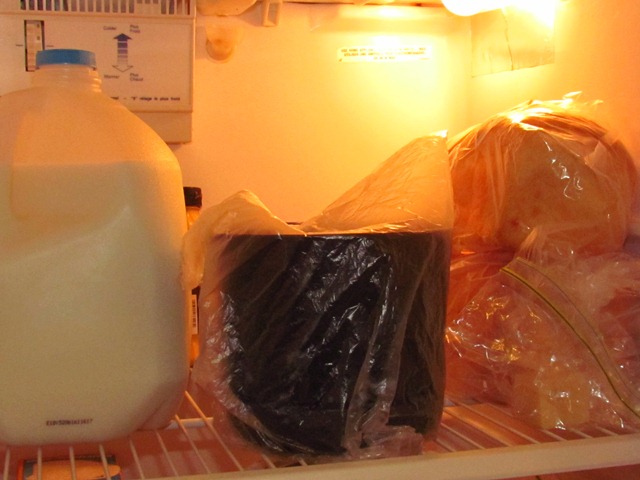
But that's not all! I still have seeds in the fridge! The holly seeds moved from warm stratification to cold stratification on October 10. I also have a bunch of cherry pits that have been stratifying since September 11. According to my sources, cherries are inconsistent in their stratification habits and can start sprouting even before being warmed up; I'm thinking I'm gonna give them six weeks.
Also, I have more seeds stratifying outside! The fun never ends here. I harvested some berries off some shrubs that had nice fall colours. One is cultivated and seems to be intended for a hedge some years from now. I believe it's called Peking cotoneaster. The other grows wild all over town and is possibly a red osier dogwood. Or some other kind of dogwood. I planted both in Planter #17, formerly home of the pumpkins. They'll die, or they'll come up in the spring. Stratifying outdoors worked out perfectly for the chokecherries, so I'm taking the view that anything I harvest out of doors (rather than from fruit bought from the store) can stratify outside.
What else... Faith and Hope are doing very well, thank you. They've been inside September 11 and are both putting on some growth. And I just bought two mandarins today, which hopefully will have some seeds in them. I'm not hungry enough to eat them right now, though. I wonder whether they need stratifying or not. China is pretty cold, but I can't think of any other citrus that needs stratification. I better google it.
That's about it for plants I'm working on right now, really. Out on the balcony, there are a few things still in bloom: poppies, "Baby Blue Eyes" nemophilas, English daisies, bellflowers, which finally bloomed on September 15 and are completely underwhelming, one convolvulus, one dianthus, and pansies. The morning glories still have flower buds on them but have been unable to open for some time now because it's not warm enough. Likewise the marigolds formed buds, to my surprise, as far back as September 11, and have been progressing slowly ever since; I doubt they'll succeed in flowering. Among the morning glories, the following cultivars did not bloom: Heavenly Blue, Kniola's Black Knight, Chocolate, and Blue Star. The thunbergia vine, cypress vine, and Darth Plant also did not flower. I'll be planting Darth Plant again next year, but not thunbergia. Undecided about cypress vine.
Also undecided is what I'm gonna do with the colossal amount of seeds I've harvested off my morning glories. The obvious answer would be "plant them", but with very few exceptions, they're from Insanity Leader, and therefore all varieties I've done several times. For next year, I'm going to get all the same varieties I had this year, and any more I can find, but I'm gonna plant one variety per container, and keep them all straight and orderly; that way I'll know what seeds I have. The current collection of seeds is really of no use to me, so I could either find somewhere inconspicuous to dump them, in which case I suspect they'll run over the town, or throw them in the garbage, in which case they will colonize the dump. Or scatter them at the dump and call it "beautification."
At this time, to be honest, I'd really like to get a nasty frost to kill everything non-hardy, so I can start winterizing. It's not really fun watching plants that aren't doing anything, and if this warm fall gives way suddenly to winter, I'll be out there in nasty weather cleaning up, and I'd rather not do that.
So, now you know.
No chance of more apricots or lychees until next year, though. What a nuisance. I hope that one lychee is still alive, but I'm not optimistic. Also, I was gonna get some catalpa seeds, but my supplier of rare seeds doesn't have them right now, and I can't find them anywhere else online. So if you know anyone who sells catalpa seeds, let me know.
Meanwhile, I brought in the Guerilla Planter, with Deng Xiao Ping, the chief aster, and, as it turns out, four pear trees that have survived being completely ignored all summer. In fact, maybe complete ignorage is better for trees than constant fussing. In any case, all four look wide awake and full of ideas. This poses a problem as to potting. Pear trees make taproots, so I don't doubt those four little trees are down to the bottom of their planter, and I'm going to need (four) tall planters for them. On the other hand, since they have taproots, they're probably not crowding into each other, and therefore repotting is probably not urgent. So maybe I can leave them alone until somewhat later. The bigger issue is that both pears and chokecherries are seasonal trees, which is to say they need a period of dormancy. Deng has shed most of its leaves, as have Liu Shao-ch'i and Peng Dehuai. Those two are staying on the balcony for the winter; Deng and the pears are inside, and the pears are bright green and not looking at all disposed to go to sleep. Will they survive a winter in the house, or will they die from sleep deprivation?
The next day, I also repatriated Planter #9, which contains the last surviving "blue" geranium, still decidedly purple but also very much alive; my oriental lily; and the globe thistles. Again, these are hardy plants, therefore I doubt they'll be happy in the house all winter, but then again, they have disappointed me, so if they die, so be it.
But that's not all! I still have seeds in the fridge! The holly seeds moved from warm stratification to cold stratification on October 10. I also have a bunch of cherry pits that have been stratifying since September 11. According to my sources, cherries are inconsistent in their stratification habits and can start sprouting even before being warmed up; I'm thinking I'm gonna give them six weeks.
Also, I have more seeds stratifying outside! The fun never ends here. I harvested some berries off some shrubs that had nice fall colours. One is cultivated and seems to be intended for a hedge some years from now. I believe it's called Peking cotoneaster. The other grows wild all over town and is possibly a red osier dogwood. Or some other kind of dogwood. I planted both in Planter #17, formerly home of the pumpkins. They'll die, or they'll come up in the spring. Stratifying outdoors worked out perfectly for the chokecherries, so I'm taking the view that anything I harvest out of doors (rather than from fruit bought from the store) can stratify outside.
What else... Faith and Hope are doing very well, thank you. They've been inside September 11 and are both putting on some growth. And I just bought two mandarins today, which hopefully will have some seeds in them. I'm not hungry enough to eat them right now, though. I wonder whether they need stratifying or not. China is pretty cold, but I can't think of any other citrus that needs stratification. I better google it.
That's about it for plants I'm working on right now, really. Out on the balcony, there are a few things still in bloom: poppies, "Baby Blue Eyes" nemophilas, English daisies, bellflowers, which finally bloomed on September 15 and are completely underwhelming, one convolvulus, one dianthus, and pansies. The morning glories still have flower buds on them but have been unable to open for some time now because it's not warm enough. Likewise the marigolds formed buds, to my surprise, as far back as September 11, and have been progressing slowly ever since; I doubt they'll succeed in flowering. Among the morning glories, the following cultivars did not bloom: Heavenly Blue, Kniola's Black Knight, Chocolate, and Blue Star. The thunbergia vine, cypress vine, and Darth Plant also did not flower. I'll be planting Darth Plant again next year, but not thunbergia. Undecided about cypress vine.
Also undecided is what I'm gonna do with the colossal amount of seeds I've harvested off my morning glories. The obvious answer would be "plant them", but with very few exceptions, they're from Insanity Leader, and therefore all varieties I've done several times. For next year, I'm going to get all the same varieties I had this year, and any more I can find, but I'm gonna plant one variety per container, and keep them all straight and orderly; that way I'll know what seeds I have. The current collection of seeds is really of no use to me, so I could either find somewhere inconspicuous to dump them, in which case I suspect they'll run over the town, or throw them in the garbage, in which case they will colonize the dump. Or scatter them at the dump and call it "beautification."
At this time, to be honest, I'd really like to get a nasty frost to kill everything non-hardy, so I can start winterizing. It's not really fun watching plants that aren't doing anything, and if this warm fall gives way suddenly to winter, I'll be out there in nasty weather cleaning up, and I'd rather not do that.
So, now you know.