Showing posts with label English daisy. Show all posts

Tuesday, September 13, 2011

First frost

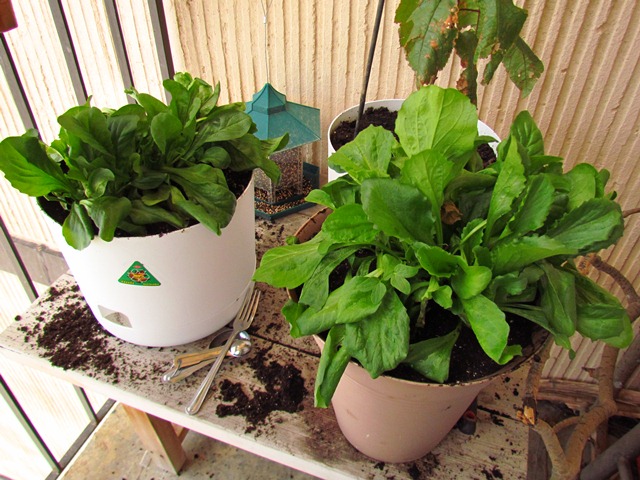
Last night it was so cold I decided the lemon trees couldn't stay outside, frost or no frost. And just in case, I also brought in the English daisies and covered up the Last Pumpkin.

I was right. There was frost in the night. Yay me!

So far, nothing outside seems affected. Most of what's out there is supposed to handle a fair amount of cold and like I said before, some of them will bloom until late October. As for the Insane Ones, they may be tropical vines, but they don't care. They're invincible.

Still, it's the beginning of the end for the 2011 garden. It's been a good one. Thank you, plants.

Friday, August 19, 2011

Asters, pansies and English daisies


Asters are at the top, and as you can see, they're thriving, and they're all pink. Either the other colours take longer to flower, or this "mix" is not very well mixed.

Pansies are at the bottom, obviously, and looking more jungleicious all the time.

And on the right are the English daisies. Half of the English daisies. The other half, that I repotted a while back, is looking like this:


Hmmmmmm...

What I seeded are two mixes and one non-mix. All three packs had pink, the two mixes also had white. So why are all the pink flowers in one planter and all the white ones in the other? Is this another case of colour being dependent on sunlight? If so that's a rip-off. If I buy a mix of pink and white I expect to get pink and white, not pink if I put it in the sun and white if I put in in part shade.

Well, there is time yet. Four more weeks until first frost.

Friday, August 12, 2011

What else is in bloom


English daisies. This was the first one, which opened August 3. There are currently four: this one, another pink one with lots more petals of which I botched the photo, and two white ones. This isn't exactly what I was after. I want the ones that make a round mass of petals so you can't see the yellow center at all. However, what I seeded is a mix and there is plenty more that haven't flowered yet, so the right ones could still be out there. And if not, there's always next year.


Asters. Yea verily, asters finally bloomed. I logged the date officially as August 4, but it took a few more days to reach this state of full openness. The strange thing is that I seeded a mix and yet only these bright pink ones are flowering. Oh well... I don't mind them. As much as they've aggravated me in the past, they're good flowers, and they did have my back when the judges came through, so maybe I'll plant them again next year after all.


Convolvuli. I'm still perplexed that only dark blue ones came up when I know I seeded a mix, but oh well. I like the dark blue ones.


Forget-me-not. They're making quite a good show, actually. I'm definitely getting them again next year.


Star of Yelta in the Wall of Insanity. This one is blooming very profusely, whereas the one at the other hand is blooming very little. Yet the difference in sunlight is less than two hours between the two. Then again... two hours is 25% less sun, so maybe it is indeed a question of sunlight. Or, maybe I just got a particularly vigorous one by chance.

Also, poppies are blooming profusely now, but mostly they're outside the railing and we don't see much of each other. There are some nemophilas and California bluebells left, not enough to make a decent photo. The geranium not only never turned blue, but also got trampled by the raven. The new plant hasn't come in the mail yet and I'm not really antsy about it.

Sunday, July 31, 2011

Guess what?


There is a bud on my English daisies.

Yaaaaaaaaaaaaaaaaaaaaayyyyyyy!

None of the plants seem to have suffered from being divided and repotted, by the way. Everything I read about transplanting goes on about transplant shock, and I've yet to lose a single plant from repotting, transplanting, or otherwise interfering with them.


Also, a second variety of nemophila. This one is called variously Penny Black, Pennie Black, or Total Eclipse.


The first aster is almost open. They must be the slowest-opening buds in the world of flowers; at least on my balcony they certainly are.


Female flower buds are starting to mature on the pumpkins.

And also, there are flowers in planter #14.4, the shady end of the Wall of Insanity. And they're Stars of Yelta. Of course. And while I appreciate their speed, I wouldn't mind to see something else for a change. I really need the other varieties to get happening so I can collect seeds before winter.

Saturday, July 23, 2011

Taking chances with my plants' lives


This is my pot of English daisies. They have no buds and they're way overcrowded. I googled to see if I could get some good advice, and the only thing I found is confusion. Some people say they're annuals, others say biennials, and yet the species name is Bellis perennis and my supplier says perennial. Or actually, I just checked: two out of three suppliers say "biennial", the third says they're biennial in warm climates and perennial in cool climates. Wow, that's so not helpful.

What I did find however is one guy who says you "should" (I hate the word "should", if you're new here) buy them from a nursery because from seed they take a long time to flower. So there you have it.

This did not solve my crowding problem, so I decided to divide them. I could also thin them, but, I've made my choice.


First I dumped them out of the pot, and you can see there are lots of roots right on the outside. That's not good for them.


I broke off two clumps (left) from the original mass (right). Separating them makes a horrible noise as the little fine roots break. Technically I know that plants can survive some root breakage and this is for their own good (I hope), but I still find that sound really awful.


Detail of the separated clumps.

I repotted the original mass. I thought I could just stick it back in the pot and pack some dirt around it, but it had lost a lot of height in all the manipulations, so I had to add quite a bit of soil to the bottom first. Then I did the other two. I didn't get the height of the clumps quite right so I had to pile up dirt over the top of the roots. Then I gave them some bone meal, to help re-establish the roots, and some water.


Hm. They still look crowded after division. Maybe I'll have to thin them as well. Or maybe some will die from being transplanted and I won't have to.

I'll let you know if they survive. (Well, duh. That's the whole point of this blog, innit?)