Friday, December 30, 2011

Baobab Friday... and all the other days

Saturday, December 24 (10 days old):


Sunday, December 25 (11 days)


Monday, December 26 (12 days)


Tuesday, December 27 (13 days)


I missed a day for some reason, then Thursday, December 29 (15 days), I didn't use the right white balance but in any case:


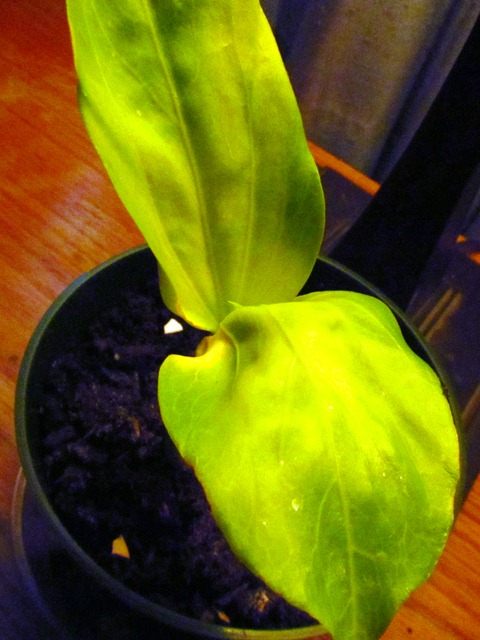
And today, Friday, December 30, at 16 days old:


Good progress so far. You can't really tell from the photos, but it's been getting taller and taller. It's taller than Za 1 ever was, but that might be just because of the lack of daylight. It's slowly turning green, and the first set of true leaves is getting started. I'm paranoid that it has too much water, or too little, or too something, but actually, it's not giving any sign of ill-health so far.

Inshallah...

Wednesday, December 28, 2011

More, more, more!

You know what's great about having your own baobab? Everyone who knows you will think of you every time they see a baobab, forever. People used to say to me "how is your dog?" or "I saw you walking your dog." Now they say "I saw a baobab on TV and I thought of you." Yay, people are thinking of me!

Also, when you have a baobab, people actually want to hear about your garden. Or at least about your baobab. People who don't know me well still ask about the dog; true friends ask about my baobab. (I suppose it would be nice if they'd ask how I am, but, you know. Baby steps.) And unlike the dog, I can go places without being asked where is my baobab. I see people at the grocery story and they ask "where is your dog?" As if dogs were allowed in the grocery store. But as I don't walk around with my baobab, people don't actually ask where it is.

Anyway.

The downside of having a baobab is, you have to have more baobabs. I suppose most of you don't know the saying "one is too many and a thousand is never enough," but it's true of baobabs, too. One baobab is too many, in that they're a lot of anxiety and way too big to keep as indoor plants. But then I was watching a documentary about Madagascar, again. That's what started this whole baobab mania in the first place. And if you watch baobab documentaries, you'll notice there is never a baobab. Baobabs are very gregarious; they form gigantic forests, further than the eye can see.

Not only that, but as you may recall, there are... I think 10 species of baobab: one in Africa, three in Australia, and six in Madagascar. A. digitata is the African one; A. za is one of the Madagascar ones. Those two are easy enough to source online, but then I discovered something else: the poster child of baobabs, the one everyone thinks of when they think of baobabs, is actually A. grandidieri. It's the tallest and "the most beautiful" of baobabs. And it's named after Grandidier, who also named Grandidier's vontsira.

This can only mean one thing: I must have a Grandidier's baobab.

A. grandidieri, however, is more difficult to source. I found a supplier, of course. I pretty much find whatever I want. It offered packs of five or bulk packs of... I don't know, 500 seeds? Or 50? I didn't look at it that closely, as I'm not after planting baobabs in bulk. I put one pack of five in my shopping cart, and then I thought better of it and put a second pack... and it told me there wasn't enough in stock.

What?

Are you suggesting that in the whole of the Intertubes, there are only five seeds of A. grandidieri to be had?

No there isn't. Not anymore, because I bought them.

But then, the supplier's minimum order is $15, and the A. grandidieri seeds are $4.90, so I added two more baobabs: A. madagascarensis and A. suarenzis. But at $4.90 each, that's still $0.30 short of the order limit. Yargh! Darn you to heck, baobabs!!!!!

I filled up my order with a cheap pack of black pepper seeds, formerly one of the most expensive commodities on earth.

My New Year's Resolution is, not to plant any more baobabs until I have a grow light for them.

What else baobabs need

Daylight. Everyone here is desperate for daylight. I think I've explained before that we're on the shore of a mighty lake which is supposed to freeze in the course of November. While the lake is open, it snows; once the lake is frozen, we get cold but clear weather which is very pleasant. Unfortunately, this fall has been hideously warm, so it's been overcast for three months. There have been a few sunny days; I remember that clearly. At least four of them. Five, even. But mostly, there is a general feeling that we haven't seen the sun in months. Everyone who has a SAD lamp is using it, and those who don't are trying to buy or borrow them.

And so with plants.

My flesh-eating aliens are now immensely tall, and one has a bud, but they're pale and I have to rotate them every day, because they lean towards the window. The monitor morning glories are all thin and pale and lying flat, though not dead. The lemon trees are dropping leaves; Hope, as always, is making a big drama of it, and Faith, as always, is stoic but nonetheless stressed.

And my new baobab is pale like an endive, and taller at two weeks of age than Digitata 1 was at three months. It must have light. And I don't have a grow light.

Luckily, I got a raise just before Christmas, so I will soon have a budget for grow lights and such things, but not until my January 13 paycheque. Then by the time I place the order and they ship me a large parcel in the mail... and hopefully it all gets here in one piece... I'm thinking this baobab needs to make it another six to eight weeks with no light.

Sigh...

Mind you, the lake could freeze in the next six to eight weeks. By the time I get the light, I might not be needing it. Who knows.

Anyway, my baobab needs light, so I put it on the desk under the desk lamp. It's not a grow light, but it's all we have for now, and plants do respond to artificial light to some extent. If I stay up quite late, by the time I go to bed, the more flexible plants are leaning towards the floor lamp I use. So, I put the baobab under the desk lamp. Hopefully that will help.

Sunday, December 25, 2011

Water for baobabs

I have developed a cunning strategy for keeping Za 7 alive: give it exactly what it wants. I don't negotiate with terrorists, but I obey baobabs.

This raises the question: what do baobabs want?

I googled it. Sadly, no one seems to have posted a precipitation graph specifically for A. za, nor can I find with any certainty where exactly A. za is most successful. In fact, I couldn't even find any specific information as to where it grows at all, except I know it's in Madagascar, and it's got to be on the west side, since that's the arid part of Madagascar.

On that note, observe what interesting things one learns from gardening. If I didn't have an interest in baobabs, I might never have learned that there is a mountain range down the length of Madagascar, the east side being exposed to the Indian Ocean monsoon, and the west side being the rainshadow side and therefore arid. But anyway.

What I did find by googling is a handful of climate graphs for a handful of cities on the island, which I then located using Google Maps. The driest one was Toliara, somewhere close to the west coast in the southern part. And the precipitation graph for Toliara is as follows:


Hmmm... Question: is this per day, or per month? I'm guessing per month, but I'd better find out for sure, so I don't misjudge my watering by a factor of 30 one way or the other.

Then I converted it into the number of milliliters of water for a 4" planter, where Za 7 is currently. It comes to about 300 mL for the dry months, up to 3 L for the three wet months. So actually, it's not really that dry. In fact, putting 3 L of water into a 4" planter in just a month seems perfectly impossible to me, unless the tree is drinking like an Irishman.

And the next question is, what part of the cycle is right now? Obviously not "December" since we're in the opposite hemisphere, but not "June" either, or at least I would think not. You'd think plants would start in the rainy season, not in the dry one. But I don't actually know. In captivity, baobab seeds tend to germinate rather randomly, and they don't like wet conditions.

Then again, does the amount of light drive the drinking? That would seem logical, in which case they need the extra daylight to use the extra water. Or not, because they're spongy; they don't really drink the water, just store it for the dry season.

Hmmmm...

I guess the moral is, I still don't know any better, except that at some point, I need to make it drink half a cup of water a day. And that's certainly not what it needs right now.

Friday, December 23, 2011

Baobab Friday rides again!


This is Adansonia za #7. It's kicking arses and taking names.

Bansai, little tree!

Wednesday, December 21, 2011

No pressure, little tree

You may or may not know that I currently work as a driver for people with disabilities. It's a nice job, but the downside is, my clients are somewhat more likely to die than the average construction worker or truck driver. (Though as to that, when I was driving in Alberta, there were drivers dying every week. It's a real bloodbath down there.)

Accordingly, one of my favourite clients died last Wednesday, December 14. She was 87 years old and had been widowed only five months, after 69 years of marriage. If you're into TV, you may be interested to know that she was the mother of Joe from Ice Pilots NWT. Because my life is that cool.

Why am I telling you this? Because the same day, my Adansonia za seed sprouted, after three other seeds failed and this one had been in the soil for two months.

As you know, I only consider a plant "sprouted" once it has broken the surface. This seed, however, was planted way too shallow, so it broke the surface when it had not even half an inch of root. And this is lucky, because it had white mold all over its shell. Because it broke the ground early, I was able to see it, wipe off the mold, remove the contaminated soil, and bury it again. But as the root kept growing, it kept pushing out of the soil, so I kept having to heap more soil over it. I though it would die for sure. As of today, though, it's still growing, and now the shell is split and you can see the baby leaves getting ready to emerge. In a few more days, it should be able to right itself and become a bona fide "sprout" rather than just a seed with a root.

But the thing is, because it sprouted the day Bertha died, I have formed a mental association between the two. Now it's like the baobab is a reincarnation of Bertha, or a memorial, or somehow a continuation of her spirit in baobab form. Now if it dies, I'm gonna feel like I let Bertha down. And it's rather likely to die, I should think, seeing as it's a tropical tree hatching in 60 N latitude on or around the winter solstice.

Nope, no pressure at all...

Saturday, December 10, 2011

Darn you, CryoVat!

Today, I destratified my holly seeds, after they had spent 60 days in warm stratification and 61 days in cold stratification.

The good news is, they didn't dry out.

The bad news is, they got mold.

Hmmm...

In the beginning, I think there were about 30 seeds. Some got buried, some stayed on the surface of the CryoVat. The mold is of a type that seems to operate only on the surface. Therefore, it is possible that there may still be live seeds in there somewhere.

Whatever.

I planted them in #18, previously a lychee / baobab nursery which never seemed to stay moist. I'm pretty sure everything in there is dead; on the other hand, it never got moldy, either. So I remoisturized it, dumped in the CryoVat, and raked it in.

When I think about it, the CryoVat was scalded soil, which may account for the mold being only on the surface. Or not. Whatever.

Then, I threw a few of my harvested morning glory seeds on top of the holly nursery. Partly because I'm not having any luck with sprouting lately and morning glories are easy to sprout, but more importantly, because I have trouble maintaining suitable conditions in my nursery planters. The little geranium pots with the coffee, kwyjibo, baobabs and cherries are always either too dry or too wet. (Good news though, no mold, except one of the kwyjibo seeds rotted completely. I'm guessing it wasn't clean to begin with, seeing as none of the other pasteurized soil has any issues.) And the thing with seeds is, you can't tell if it's too wet or too dry until they're dead. So I figure, morning glories will let me know whenever it's too dry, and absorb excess water quickly when it's too wet.

That being said, if you're gonna try the same thing at home, don't go too crazy with them. Morning glories are jungle plants, they can tolerate disgustingly wet conditions that favour mold. In fact, jungles are pretty much built on mold. So just because your morning glories are happy, doesn't mean everyone else is ok. It's just a guideline, really.

To get back to my poor holly seeds, now that they've spent four months in stratification, they're still supposed to take "16 months to three years" to sprout. That is to say, we should get something some time between February 2013 and October 2014.

Um...

That's not gonna work. I can't say for certain that there are any mold-free seeds now, but I'm pretty sure there won't be in three years.

Thus the moral is, I must try again. But this time, I'll seed them outside in a large container. That seems to work much better for stratification than messing with small containers in the fridge. If I seed them at the end of June, they'll have two warm months and two increasingly cold months, and then come inside just as the ground is freezing outside. That's a much better approximation of natural conditions.

Better yet, I'll make two batches. One will come inside at the end of October, one will stay out on the balcony. The more methods you try, the more you might succeed.

Also, I need to identify the perfect monitor plant. It has to be fairly shallow-rooted, to monitor conditions near the surface, where the seeds are; and it has to be fussy about moisture levels, and have a clear way of communicating when it's unhappy, and whether the problem is too much or too little water.

Hmmmm... I'm thinking nemophilas.

Ah well. As I always say, there's always next year.

Monday, December 5, 2011

I like you, plants

Yesterday, I moved the aliens from under the piano to a "sunnier" spot. Of course there is still no sun and the lake is still open so there will not be sun for a long time. Anyway, I moved them to a better spot. I also measured the leader. It was 8" tall yesterday, but it was leaning towards the lack of sun. I rotated it, and now it's looking straighter and taller. They have still made no attempt to devour the dog and me. I'm hoping that by establishing a good rapport with them now, I can sic them after my enemies come summer.

Later that day, I watered... I don't remember what, but I know it's in my log.

Today, I watered Deng Xiaoping. It's more than doubled in size since it started leafing out. It's got lots of pretty, small, pale leaves. And it's still a rebel, obviously.

Sometimes I check on my hard-to-hatch seeds that never hatch. They can't win forever. There is plenty more where they came from.

Do I have a point?

Probably not. But plants are good company, in a way. They don't talk much, but they're always up to something interesting. (Except sometimes they die, but then, so do people. Plants are better company while they're alive.)

Wednesday, November 30, 2011

Still alive!

The third flesh-eating alien hatched about two days ago. The first one is now at least three inches tall. I don't want to provoke it by approaching it with a measuring tape, but it's clearly growing very fast. Nonetheless, so far none of the aliens have tried to attach themselves to myself or the dog. Phew!

Sunday, November 27, 2011

Now I'm angry

I have two bowls for the ravens, a red one and a yellow one. They know what they're looking for, and they can see whether there is food in the dish as they fly by. It's a bit of a code between us.

Today, the weather was really nasty, so I put food out early instead of waiting for Chicken to come by. Several ravens came. Given the blowing snow, there wasn't much else they could do if they wanted to eat today.

Each raven started picking up food and taking it away to a cache... until one smartass decided that the bowl itself is the source of food and it would be easier simply to take the bowl home.

You stupid bird!!!!!!

I thought ravens were supposed to be smart. Chicken knows that I fill the bowl, the bowl doesn't fill itself. This other idiot bird just totally took me for granted and stole my red bowl. I bet you anything it was a male raven. Men totally do this sort of thing.

Now I'm mad.

Saturday, November 26, 2011

More bait of Satan!

I got a new seed catalog in the mail. This one is from Stokes. I haven't shopped from them before, but I'm about to.

As far as seeds, Stokes isn't exactly up my alley. They supply not only gardeners but commercial growers, so they have a very large selection of vegetable seeds, which they can ship in staggering quantities. But since I'm not into growing food and there is only one of me anyway, that's rather beside the point. Their flower seed selection is, predictably, more "commercial" than what I'm after. They sell the stuff people buy; I'm more into the stuff people have never heard of.

There are, however, two very attractive features in the Stokes catalog. One is their selection of pansies. I'm in love with pansies since my Matrix experience this summer, but unlike Ipomoea, I have no desire to collect every pansy cultivar ever created. Moreover, there are many pansies I totally don't like. So far I had only found a few choices, mostly as mixes, and although I love the Matrix mixes at Veseys, I was displeased with the overall selection from my suppliers. Stokes, on the other hand, offers over 100 varieties of pansies. I kid you not. And they're packed by variety, not just as mixes. I've picked out about 14 so far that I want. The only downside is that some of them are not available in less than 250 seeds. Oh well... Seeds keep.

And point 1b, they also have twice as many varieties of pumpkins as Veseys. Mmmmm... Pumpkins...

The other thing about Stokes is, clearly they must be getting volume discounts along the way, because a lot of their gardening tools and supplies are much cheaper than at Veseys. For example, the same heat mat that Veseys sells for 39.95 is 28.99 at Stokes. That timelapse plant camera I want is 119.95 at Veseys, but only 86.99 at Stokes. And, most importantly, they have a grow light for only $71.99. That's considerable cheaper than anything at Veseys. Still not within my current budget of $0, but once the budget increases to above zero, I can definitely afford a $72 grow light. That will make a world of difference, I think.

211 days until last frost...

Friday, November 25, 2011

The Great Pumpkin Problem

I may have mentioned, repeatedly, that I have a problem with pumpkins. Namely, they don't grow fast enough. But the cool thing is, so does everybody else here. So it's not me being inept at pumpkins; there really is a pumpkin problem here.

While looking at the times-to-maturity of different varieties, to see when I should start them for a mid-August maturity, I quickly realized where the problem is. The average time from transplant to maturity, between all the varities offered by my supplier, is 96 days. That means having to transplant out on May 11.

Haha, very funny. There is still snow on the ground on May 11. Nothing can get planted out until the end of June, and keeping a pumpkin indoors for two months is a nuisance, as they spread over the floor like... fleash-eating aliens, or something.

I must think of a solution.

Another one!!!!!

The third flesh-eating alien hasn't emerged yet, but while tidying up in Planter #9, where the herbaceous perennials from the 2011 garden are wintering, I discovered something else. Presumably it's the oriental lily coming up again, which is annoying because it bloomed too soon "last" year, which was really this year but last gardening season, and now it's going to bloom even sooner and I'll have no lilies at all for Yards in Bloom.

On a positive note, the fact that this is almost certainly a lily suggests that the ones in Planter #21 might also be lilies, and not, as I thought, flesh-eating aliens.

Thursday, November 24, 2011

They're coming outta the walls!


See this?

I shot it on Tuesday, when I went to check the moisture in my incubators. The thing on the right, obviously, is a zombie morning glory that's starving for light. The thing on the left is one of those flesh-eating aliens that I received from Veseys on October 27 and had to plant indoors because it was too late to put them outside.

Aaaaaaaaaaaaaaaaaaaaaaaaaugh!

The aliens are coming. This one was actually probably two days old already when I spotted it. As of this morning, there is a second one. Unless the third one rotted to death, which doesn't seem plausible given the success of the first two, it won't be far behind.

Sigh... Now we're all gonna die.

And another thing that's been going on for at least two weeks is this:


This is a crappy photo because the light was miserable, but you can see it's Deng Xiaoping. And it's leafing out. What the Ford? What kind of tree leafs out in early November????


This is bad. Either the flesh-eating aliens are going to kill everybody, or they're actually lily bulbs, then they'll flower in December and be unavailable when Yards in Bloom judging rolls around. And Deng Xiaoping is going to have to keep those leaves for 10 months, which isn't necessarily the end of the world, but not what a mayday tree needs, either. This is absolutely the worst time of year for plants to be growing.

See, if you ever look at a map, you'll notice that Hay River is on the south shore of Great Slave Lake, one of the largest lakes in North America. This time of year, when it's well below freezing but the lake is still open, steam rises off the lake, thusly:


That big cloud isn't a storm, it's steam off the lake. When the wind is from the south, as it was that day, we get bright clear skies with a menacing cloud to the north. When the wind is from the north, the cloud blows over us, and it gets overcast, and it snows. And if it's a strong wind, it breaks up the thin ice on the lake, thus retarding freeze-up. Once the lake is completely frozen over, it stops snowing and we get mostly clear weather until break-up. And this is why, if you're obsessively tracking my photography, you might notice that I have almost no photos shot in November. Of any year. Because there just isn't any light here in November.

Back to my garden, therefore, plants shouldn't try to grow in November, because there just isn't any light. No one has seen "direct sunlight" in weeks. And even if the weather cleared up, the hours of daylight are still decreasing for another month. If my house plants want to go nuts in January, that's fine by me; by then we get actual "sunlight" and it's increasing. Plants that grow in November are either going to be spindly and pale, or they're gonna need a grow light. And as I've already mentioned, I can't afford a grow light. Plus there's nowhere in my apartment to set up a light garden, really. Though I suppose I could find a way. I always find a way.


Well, I suppose all this is irrelevant now that we're about to be picked off one at a time by flesh-eating aliens, right?

Wednesday, November 23, 2011

Waaaaaaaaiiiit a minute...

Ravens can't read, but then again neither can most construction workers. (Technically, most people are functionally illiterate, but that's beside the point of this blog.) However, construction workers can read pictograms, and I'm pretty sure ravens are smarter than construction workers.

In conclusion, I need to make a pictogram that a raven can interpret as "don't crap in food dish."

Even more reasons I'm single

Ok, this has nothing to do with gardening, but since I started writing reasons on this blog, you're stuck with it.

On Sunday, my car didn't start. So I went and got my work vehicle and my cables, boosted my car, and went about my day.

Gasp!

You'd think that knowing how to boost a car wouldn't be the end of the world. I mean, considering that the guy I like to look at has been with a woman who beats him for a few years (off and on, after his off-and-on relationship of many years with his abusive ex-wife ended), you'd think that knowing how to boost a car would be somewhat forgivable.

The only thing is, a more likely to get laid woman would have gone looking for a big burly dude with a big burly truck and let him do the boosting. And refrained from pointing out that almost every big burly dude in the world will inevitably connect the cables wrong.


Ok, here is another reason that actually has to do with the garden. Now that it's cold and snowy, I've started feeding my raven again. Wait... That's one reason right there. But actually, there seem to be currently as many as three ravens: Chicken, his girlfriend Squeaky, and another guy named Hoggle whom Chicken beats up whenever he sees him. (Naming ravens: two reasons.) But most importantly, ravens don't care where they crap, and in particular, one crapped in the food dish this morning. And I don't like to have to wash bird crap off my dishes. Who knows but they might carry psittacosis, or something. (I can spell "psittacosis" and I know what it is: three, four reasons.) So I was thinking how to prevent that, and being also an Occupational Health & Safety leader (four reasons), the first idea that came to me is to write them a sign. "Ravens: please refrain from crapping in food dish."

Yes. I'm sure there is hope for spinsters who write OH&S signs for ravens.

And you know what's really sad? Even though I obviously know that ravens can't read, the OH&S leader in me refuses to let go of the notion that this is obviously an occupational hygiene problem and occupational hygiene problems can be solved by signs.


And another reason I'm single is, I actually wrote all these thoughts.

Thursday, November 17, 2011

Er... not so much

I googled "solar-powered grow lights" and as I predicted, lots of hits came up. And as I should have predicted if I had bothered to think about it, most were targeted to the grow-op demographic. As it turns out though, you'd pretty much have to have a grow-op to make it worth the money, because solar-powered grow lights are incredibly expensive. I mean six, seven hundred dollars.

Yeah: I don't think so.

Mind you, the grow light itself is quite expensive, but even accounting for that, the cost of the whole thing is prohibitive. It would take years to save enough on power bills to recovered the initial outlay. Same with hybrid cars, by the way. I wanted to buy a hybrid, but then I discovered it would take twenty years to save enough on gas to make up for the higher sticker price.

In management (yes, management is one of my many unused skills) we learn that training employees is pointless; instead you just have to "make the right thing easy and the wrong thing hard." Sadly for the environment, the right thing is almost always considerably harder than the wrong thing.

You know what I'm gonna do instead? I'm gonna buy a solar meter. It's a little device that you stick in the ground, and after 24 hours, it tells you whether that spot is full sun, part sun, or full shade. Then I'll do the math, and if I find it's really worth it, I'll just buy a regular grow light and run an extension cord to the wall. I've been meaning to do that (the extension cord, that is) in any case to plug in other environmentally-wrong devices such as heat pads (if my hotbox proves insufficient to winter the plants), Xmas lights, and a heat lamp for my raven.

Speaking of which, another thing I need is a dog house for my raven. As I keep telling you, gardening is so wild, it makes psychedelic drugs redundant.

Saturday, November 12, 2011

Pray for my baobabs!

Currently I have six baobab seeds on the go, but I'm pretty sure one is dead and a second is not moving. Of the other four, two have been in the dirt for a long time, and two were just planted two days ago in pasteurized soil. I'm refraining from checking on them on the grounds that if they're alive, they don't need me bothering them, and if dead, there's nothing I can do about it.

In addition, there is still a lychee, which I think is dead; two kwyjibo seeds; three Robusta coffee seeds; 27 freshly destratified cherry pits; and the holly seeds that still have one month to go in the CryoVat. And then of course the dogwood and cotoneaster seeds in the outdoor CryoVat.

That's not all! There is also the peony root, the three alien spores, 12 tulip bulbs sleeping in the fridge, and 18 bulbs of various species spending the winter outside in the Jungle.

Why am I on about this? Because some weeks ago I read an article about the efficacy of prayer. You see, I'm a Lutheran, and I would say a fairly devout one. Though of course since Lutherans are fairly rare (about 0.26% of Canadians, if I'm not mistaken), I only meet them at church, and ipso facto every Lutheran I know is "fairly devout."

Be that as it may, I don't believe in prayer.

GASP!

How can you be a devout Christian and not believe in prayer? Because we Lutherans believe in thinking about what we believe, whereas most people consider that faith and reason are intrinsically incompatible. But if you look at prayer logically in the context of what we believe we know about God, it should be self-evident that prayer, as most people do it, is useless. There are three things you can do with prayer: give glory, give thanks, or admit you're powerless and affirm your trust in God. Most people, however, use prayer to make long to-do lists for God, and therefore expect that God will manifest his approval by getting some of the to-do list done. And then they'll tell you "prayer works."

All right then. I set out to find out what evidence there is of the efficacy of prayer. Because one thing I can tell you for sure, I've read the entire New Testament, and nothing in it supports the idea that you can tell God what you want and he'll get 'er done for you. So if there is evidence for the efficacy of prayer, given that it isn't supported by the Bible, it better be supported by something very, very convincing.

Promptly I found an article titled Scientific Research of Prayer: Can the Power of Prayer Be Proven? by Debra Williams, D.D. (1999 PLIM Retreat, (c) 1999 PLIM REPORT, Vol. 8 #4).

Ok, first of all, "D.D." means "Doctor of Divinity". I have a B.Sc., "Bachelor of Science." That means I have scientific training and she doesn't. So I feel competent to question her findings. Or lack of findings, insofar that the article isn't original research, but a survey of some of the existing research. In particular, I find the following statement: "In a study on germinating seeds done by Dr. Franklin Loehr, a Presbyterian minister and scientist, the objective was to see in a controlled experiment what effect prayer had over living and seemingly non-living matter. In one experiment they took three pans of various types of seeds. One was the control pan. One pan received positive prayer, and the other received negative prayer. Time after time, the results indicated that prayer helped speed germination and produced more vigorous plants. Prayers of negation actually halted germination in some plants and suppressed growth in others."

Hmmmmm...

Most interesting. Further on, regarding an experiment using bacteria:

Bacteria presumably do not think positively or negatively. Another major advantage of microorganisms in studies of distant mental intentions has to do with the control group. If the effects of intercessory prayer, for example, are being assessed in a group of humans who have a particular illness, it is difficult to establish a pure control group that does not receive prayer. The reason is that sick human beings generally pray for themselves; or outsiders pray for them, thus contaminating the control group, which by definition should not receive the treatment being evaluated.

In studies involving microbes, this notorious "Problem of Extraneous Prayer" is totally overcome because one can be reasonably certain that the bacteria, fungi, or yeast in a control group will not pray for themselves. And that their fellow microbes will not pray for them.

If the study involved negative intentions instead of positives, the advantages remain the same. The thoughts of microorganisms do not influence its outcome.

Jean Barry, a physician-researcher in Bordeaux, France, chooses to work with a destructive fungus, Rhizoctonia Solani. He asked 10 people to try to inhibit its growth merely through their intentions at a distance of 1.5 meter.

The experiment involved control Petri dishes with fungi that were not influenced in addition to those that were. The laboratory conditions were carefully controlled regarding the genetic purity of the fungi and the composition of the culture medium, the relative humidity, and the conditions of temperature and lighting.

The control petri dishes and the influenced dishes were treated identically, except for the negative intentions directed toward the latter. A person who was blind to the details of the experiment handled various manipulations. The influences simply took their stations at the 1.5 meters and were free to act as they saw fit for their own concentration. For 15 minutes each subject was assigned five experimental and five control dishes. Of the ten subjects three to six subjects worked during a session, and there were nine sessions.

Measurement of the fungi colony on the Petri dish was obtained by outlining the boundary of the colony on a sheet of thin paper. Again, someone who did not know the aim of the experiment or the identity of the Petri dishes did this. The outlines were then cut out and weighed under condition of constant temperature and humidity. When the growth in 195 experimental dishes was compared to their corresponding controls, it was significantly retarded in 151 dishes. The possibility that these results could be explained by chance was less than one in a thousand.

Hmmmmmm...

You see, I'm pretty sure that this proves the opposite of anything, but first of all as the more educated scientist here, I take exception with the idea that "one can be reasonably certain" that micro-organisms cannot pray for themselves or each other. In fact eukaryotes very much have the ability to sacrifice themselves for the good of the colony, so whatever non-thoughts go on in their non-brains, I think the last thing I would want to assume about them is that they're not capable of wishing for the well-being of their peers with all their non-heart, with all their non-soul, and with all their non-mind.

Regardless, if we make the assumption that humans have far greater capacity for prayer than bacteria, we can still explain this result as a sign of the power of prayer, in a sense. But if we grant (which I haven't so far) that this proves that prayer does indeed reliably control the growth rate of bacteria, then it also proves that the mechanism by which prayer works has nothing to do with any Higher Power. If the power of prayer lay in the ability of humans to dictate the actions of a Higher Power, then most certainly this experiment would have failed, because the Higher Power would not waste its time speeding and slowing the growth of bacteria over and over as the humans dictate. If there is a Higher Power, then by definition we do not have power over it, therefore we can't make it do this sophomoric little trick with the bacteria every time we ask.

So apparently, attempts at scientific investigation of the efficacy of prayer have shown us two things: 1) prayer makes plants grow faster and 2) this is completely independent of a/the Higher Power. Which means that it isn't necessary to believe in any Higher Power, or in the efficacy of prayer in influencing said Higher Power, in order for prayer to make plants grow.

Ha.

Well actually, that's rather to my advantage. If I believed God listens to those whiny lists of demands and goes out of his way to comply, I certainly wouldn't pray for something as irrelevant as a baobab seed. But since obviously this has nothing to do with God, and since there is some rudimentary support for its effectiveness, it's worth trying. So if you're NOT the praying type and/or you do NOT believe in a Higher Power, please pray for my seeds, bulbs, roots, rhizomes and alien spores. Because the more you do, the more I'll have to blog about.

QED, yes?

Ok, so here is what I need

I was contemplating the sad problem of my balcony. You see, most of it is in part shade, and some is in full shade. And most plants I like want full sun, which is at a premium on this balcony.

An obvious solution would be to move to an X07 apartment, which has a southeast exposure, whereas X01, where I am now, is a northeast exposure. But the X07s are one-bedroom and therefore much more expensive. Besides, the one on my floor is already taken, and I like my floor. Plus, I don't want to move. So no.

Second solution: grow plants that like shade.

Meh. I grow plants I like. I'm not gonna grow plants I don't like just because they like it in the shade. If I see a shade plant I like, I'll get it, but otherwise, no. Though as to that, pansies, nemophilas, and allegedly the non-blue geranium, all do quite well in the shade. So I could sow my upcoming Sea of Pansies on the shady side, I suppose.

Third solution: get a grow light. That's what you do when plants don't get enough light, right? So I could get a big grow light and mount it to the underside of the balcony above. But then I'd have to pay for electricity, which is stupid. I'm not wasting power on making plants grow.

Fourth solution: get a solar-powered grow light. Is the idea of a solar-powered lamp ridiculous? Sounds ridiculous. Nonetheless, I would almost bet money that if I google, I'll find solar-powered grow lights somewhere. And if not, it doesn't matter much, because you can get a solar panel and a grow light separately anyway. Then I can mount the solar panel on the sun side and the grow light on the shade side, and as long as the sun shines on the sun side, the lamp will shine on the shade side.

Gardening is so surreal, it makes psychedelic substances redundant.

Perlite rocks!

I don't know what perlite is. I mean, I know that it's a white granular substance and what it's used for, but I don't know what it's made of, where it comes from, or why it does what it does. I do know that perlite is awesome.

Consider this: I just de-stratified some cherry pits which had been in a cryovat full of only perlite for six weeks; the perlite was still moist, and there was no mold whatsoever. In contrast, all my previous soil-based cryovats developed mold sooner or later, and had to be destratified early, or simply failed. Now I can't say for sure that these cherry pits are still alive, much less that the dormancy has been broken, but at least I can tell you for a fact that they are neither moldy nor dried out. So if I fail to get a sprout out of 27 seeds, it won't be the perlite's fault.

See, when you stratify seeds, like I keep saying, they're exposed to Killer Fungus for extended periods of time, in their most vulnerable state. So ideally you want a "sterile" medium. Not "sterile" in a surgical sense, obviously, but more in the sense of "not having the ability to sustain life." Many websites suggest wet paper towel, but this does not regulate moisture very well. When you put water on it, it gets soaked right away, and then it dries out right away. Perlite, on the other hand, absorbs water and apparently releases it very slowly, so that it changes very slowly from "wet" to "dry" or vice-versa. And it does not support the growth of mold.

Great. Now I just need to sow all my seeds in perlite, and I'll be set for life, right?

Well, we'll see. Meanwhile, I scalded the cherry pits, because I have a hard time believing that a sprout can break such a hard shell. Obviously, I should have boiled only half, to have a test group. Oh well... If these don't sprout, there's always next year.