Saturday, November 12, 2011

Perlite rocks!

I don't know what perlite is. I mean, I know that it's a white granular substance and what it's used for, but I don't know what it's made of, where it comes from, or why it does what it does. I do know that perlite is awesome.

Consider this: I just de-stratified some cherry pits which had been in a cryovat full of only perlite for six weeks; the perlite was still moist, and there was no mold whatsoever. In contrast, all my previous soil-based cryovats developed mold sooner or later, and had to be destratified early, or simply failed. Now I can't say for sure that these cherry pits are still alive, much less that the dormancy has been broken, but at least I can tell you for a fact that they are neither moldy nor dried out. So if I fail to get a sprout out of 27 seeds, it won't be the perlite's fault.

See, when you stratify seeds, like I keep saying, they're exposed to Killer Fungus for extended periods of time, in their most vulnerable state. So ideally you want a "sterile" medium. Not "sterile" in a surgical sense, obviously, but more in the sense of "not having the ability to sustain life." Many websites suggest wet paper towel, but this does not regulate moisture very well. When you put water on it, it gets soaked right away, and then it dries out right away. Perlite, on the other hand, absorbs water and apparently releases it very slowly, so that it changes very slowly from "wet" to "dry" or vice-versa. And it does not support the growth of mold.

Great. Now I just need to sow all my seeds in perlite, and I'll be set for life, right?

Well, we'll see. Meanwhile, I scalded the cherry pits, because I have a hard time believing that a sprout can break such a hard shell. Obviously, I should have boiled only half, to have a test group. Oh well... If these don't sprout, there's always next year.

Wednesday, November 9, 2011

What else can I pasteurize?

The thing is, there is no point pasteurizing your soil if you're going to touch it with the same germy tools you use in the contaminated soil. So then, you're supposed to pasteurize / sterilize everything that will come into contact with the soil. And me without an autoclave...

Ok, I boiled some forks and spoons, which I will be using to scoop the soil into the pots and cultivate it. I didn't boil the containers themselves, which are 4" geranium starter pots. Being made of plastic, I don't think they'd take kindly to boiling. I did wash them with dish soap, as I don't have bleach on hand just now. These pots have never been used anyway, so there is no reason they should have seed-eating vermin in them yet.

You know what else might be carrying vermin though? The seeds. What if there is vermin on the seeds? I guess the baobab seeds are safe since I boil them before seeding anyway, but what about the kwyjibo seeds?

Ha. If you thought gardening was a sound, relaxing pastime, you've come to the wrong blog.

Tuesday, November 8, 2011

Stink, darn you! Stink!

After about 25 minutes at "250 F", the soil was emitting a not unpleasant smell of hot soil. I figured, let's turn it up higher, then it will stink.

So I crank it to "300 F", whatever that is in real temperature inside the oven. As the temperature rose, however, the soil started to make a crackling sound, suggesting boiling water and therefore that it was too hot. I opened the oven again and found that the noxious fumes were stronger but the smell of soil was if anything weaker than at "250 F". So I turned it down, then back up, then back down.

Then I got tired of the whole thing and turned the oven off. My eyes are burning and I want to go to bed. Hopefully this killed some of the evil in the soil and my hard-to-hatch seeds will stand a better chance. If not, meh... There's always more seeds where those came from.

How to pasteurize soil

Actually, I have no idea, in that I'm quite sure I'm not in the process of succeeding. But in theory, here is how you either pasteurize or sterilize soil, depending who you ask.

Moisten soil, to the moisture content you want for planting. Put soil in an oven-safe dish, no more than four inches deep (the soil, not the dish). Cover tightly. Stick a meat thermometer into the soil. Then, heat the soil until the internal temperature reaches 180 F, and maintain this temperature for 30 minutes. Done.

First caveat: allegedly, this process produces a foul odour. Second caveat: allegedly, if you cook your soil to 200 F, it will produce toxic chemicals that will kill your plants.

Ok. Whatever. I wasn't gonna try it, but I'm getting more and more seeds that are expensive (as seeds go) and hard to germinate, and which therefore spend a long time in the ground getting eaten by the fungi. Usually I just pour boiling water on the soil, on the theory that more heat for a shorter time works for milk, and what's good for milk has got to be good for soil. Nonetheless, I decided that perhaps I should try the real deal. Except I don't have a meat thermometer, nor did I feel like buying one, so I thought, "meh."

Ok. I wet the soil, put it in the dish, covered with foil, preheated oven to 180 F. Except the markings start at 200 F, so that was a best guess anyway. And then I suddenly remembered that the last time I used this oven, being in 2009, it didn't work right and took hours to bake anything, and I had to turn it way up. Hmmmmm... Then I remembered that allegedly it was repaired in 2010, but I haven't baked since, so I have no idea whether it's really fixed.

Hmmmmmm...

I used to bake and cook, you know. Before I became a bitter old spinster. But anyway.

After the soil had been in the oven 15 minutes, I decided it mustn't be working, because there was no foul odour. But then I noticed corrosive fumes, which however were not previously mentioned, and might be caused, possibly, by the oven being dirty, or maybe there are cobwebs in there or whatever. In any case, I figured that corrosive fumes were just as good as foul odours. I opened the window, which was stupid since I only just yesterday got the landlord to put the heat up, after the temperature in my apartment had reached down to 62 F. Then I went to walk the dog, leaving the oven on, the window open, and some scented candles burning, none of which are safe practices. Oh well. My Field Level Risk Assessment tells me this was a low-priority hazard.

Returning from my walk 45 minutes later, I detected more corrosive fumes, but still no foul odour. I opened the oven, still no foul odour. Hmmmm...

At first I decided to leave well enough alone, until I remembered that soil most definitely produces a characteristic smell when you pour boiling water on it, and therefore if it wasn't smelling, it really mustn't be hot enough. Stupid oven... And stupid me for being too lazy to get that meat thermometer.

So, at the time of writing, the soil is still in the oven, now cranked to 250 F, the window still open, and still no foul odour detected. Sigh... I'd really like to go to bed, you know.

Now you might be thinking that the question is not so much "how" as "why" I'm pasteurizing soil. Simple. As you recall, some seeds rot instead of growing. This is due to vermin in the soil such as larvae, fungi, molds, bacteria, and who knows what else. Also, all my soil is riddled with zombie seeds. Pasteurizing is supposed to get rid of just about every living thing in the soil, so your seeds don't get eaten.

Wait and see, I guess. Or keep calm and carry on. Or something.

The kwyjibo tree

I got some seeds in the mail this morning. They're called "crocodile bark jackal berry."

What's a crocodile bark jackal berry?

I have absolutely no idea. I was looking for something else and I saw the name, and the supplier didn't have a picture, and it was "only two bucks." Like I always say, everything is "only two bucks" until you buy 150 of them.

So, now I have five seeds of crocodile bark jackal berry. I could google it, but I'm not going to; that way it will be a surprise. Assuming I can even get them to sprout, as tropical seeds are a bit of a bother. But the thing is, Blogger post tags can only be 255 characters total, and "crocodile bark jackal berry" is 28 characters, so that's a waste of space. So for the sake of brevity, it will henceforth be known on this blog as the kwyjibo tree.

So now you know.

Monday, November 7, 2011

The new love of my life

THE love of my life is my dog, the incomparable Tinky-Winky. Followed by the man known as The Handsome One, whom I've been stalking for years. Sadly, the only way I'd be any less his type is if he were gay. But other than that, I found the new love of my life today: Summer Hill Seeds.

If you go there and search for "morning glory", it returns 54 results. Fifty-four (54) results. Really.

At last, someone who's as crazy for Insanity Plants as I am! (Haha, what a crappy pun.)

I sure hope the quality of their seeds is as good as the quantity. 54 types of insanity... Mmmmmmm... (drool)

Sunday, October 30, 2011

You know what I forgot?

Roses. I totally forgot to order up some roses. All my cuttings laughed themselves to death in the fun gel, so I was going to order some roots in the fall, particularly J.P. Connell. I thought I had a list somewhere, but I can't find it. Anyway the supplier I had found will not ship fewer than three plants, so I was thinking of getting J.P. Connell, Alexandre Mackenzie and Reine des Violettes. But I totally forgot.

Oh well.

Like I always say, in the garden, there's always next year.

The bait of Satan

That's the title of my Tuesday night Bible study class. Bible study always makes me think of Fight Club: "it's cheaper than a movie and there's free coffee." Anyway.

You know what the real bait of Satan is? Seed catalogs. I said it before and I have seen no reason to change my mind: seed catalogs are the work of the devil. They're full of lurid temptations.

See, in my fall bulbs order from Veseys, there wasn't just bulbs, but also, a catalog. the "spring 2012 advance sale" bulb catalog. Now bulbs are easier to resist than seeds, because they're much more expensive and you have to actually have a place for them, not just figure "oh, I'll put them in the Jungle, they'll be fine." You can seed 4000 seeds in a big pile and tell yourself it's ok; bulbs won't let you do that. So to make sure you buy these advance spring bulbs, Veseys is offering $35 off any orders above $75 from that catalog. Not from seeds or from any other catalog, but strictly from the advance spring bulbs.

Hmmmmm...

So I open the catalog and the first thing I find is a really beautiful peony for... $39.95.

Ha.

On the one hand, that's an expensive peony, especially considering it's a herbaceous and not a tree peony. On the other hand, it really is beautiful, and no one else in town has it, and peonies activate your feng shui. And besides, if I buy this peony, plus another $0.05 of product, I get $35 free. Oh, and also, your credit card doesn't get charged until they're ready to ship in the spring, so it doesn't matter that I don't have the money right now.

The funny thing is, there wasn't really another $35.05 worth of product I wanted in that catalog. A lot of perennials don't really appeal to me in the first place, and in any case they're not hardy for Zone 0a. But like I've said before, zone, schmone. Peonies are supposed to be hardy to Zone 3 and they're all over this town. Maydays are hardy to Zone 2 and some of the tallest cultivated trees in town are maydays. (If you're here in Hay River, check out the one at 8 Mansell. That is one crazy mofo.) In addition, my balcony is a warmer climate than most of the town. I get more hours of sunlight, less frost and more heat. Only the hollyhocks at 39 Riverview lasted almost as long as my pansies, but even they died in a hard frost when my flowers were still alive. So I figure anything that's Zone 3 is fine, Zone 4 is plausible, Zone 5 is a stretch. On the other hand, anything that has Zone 5 as its cold limit typically goes to Zone 8 or Zone 9, which is to say it doesn't need really cold weather to set flowers, so it can probably be brought inside. And some plants can also be dug and stored, particularly tulips. The others are of limited interest to me.

So... Where does that leave us? Still not wanting $35.05 of product from this catalog, but since it was free, I ordered some oriental lilies, toad lilies and windflowers. I covet the windflowers in every catalog and I always don't get them because they're only hardy to Zone 5, but, we'll see.

So, if I can remember to load up some money on my credit card in spring when they go to ship this, I get a spectacular peony that no one else in town has, plus $35 of free flowers. And that ain't not bad. And that, I suppose, is exactly why Veseys does this. Because they just sold me an extra $35.05 of flowers. For free, mind you, but I'm assuming their markup is so grotesque that they can absorb this promotion easily.

Seed catalogs: truly the bait of Satan.

Saturday, October 29, 2011

Welcome to the Winter Garden

Here is what's going on in the Winter Garden, that is, my living room. (I live in a bachelor suite, so my "living room" is also my bedroom, music room, office, kitchen to the extent that there is no wall between the two, and tropical plant conservatory.)

  • Planter #8: one Passiflora edulis that survived my complete lack of effort and some overwatering over the summer. Also there are some seed pods I harvested off an unidentified yellow-flowering plant in someone else's yard, and an avocado pit that I've buried in there, but I'm gonna dig it up because it's probably just rotting instead of sprouting.


  • Planter #9: the oriental lily, having now shed all its leaves and been cut back to the ground; the alleged "blue" geranium, still alive, still not blue; and two or three globe thistles, one of which is putting forth some new growth. I don't expect much from any of these, but that's no big deal. I'll get more globe thistle seeds in the spring, and the other two never meant much to me.


  • Planter #10: two pear trees.


  • Planter #11: the Hope lemon tree, beautiful as always though currently dropping leaves. I gave them 6 L each of water around October 13, when they seemed to be finally thirsty, and as a result they are again showing signs of being over-watered. In addition, they are getting no light lately, October being a particularly bad month for sunlight. People think we lack light in winter; in reality, the real winter months have lots of beautiful sunny days, but while the lake is open in October and November, we get mostly overcast skies and precipitation. It's depressing for people, and makes lemon trees pale and sad.


  • Planter #12: the Faith lemon tree, again showing its strength compared to Hope by not complaining so much about the circumstances. On the other hand, and I'll tell you more in a later post, Faith has the problem of very poor branching habits so far, so that I have the choice of pruning almost everything off or letting it go on with really crowded branches until a path suggests itself.


  • Planter #13: two pear trees.


  • Planter #18: baobabs and lychees. This planter is now in a dark corner against the heat register, after I read a post on a gardening forum from someone who couldn't get his kaffir lemons to sprout until he built them an incubator and raised the temperature to 35 C. That reminded me that my original baobabs were sprouted in June, so in warm weather, and my lemons were sprouted by leaving them against the heat register for a month. So I hie the planter thence, and sure enough, now I have a digitata sprouting. Perhaps even two digitatas, as I planted the dried-out (I thought) seeds from the previous attempt, and I seem to be seeing two roots. However, time will tell. At least one za seed is not sprouted yet; I know because I removed some surface mold with a fork and found it, the mold, had reached the seed. So I washed off the seed, which seems healthy though not cracking yet, and replanted it. As for the lychee, I'm not touching it. I can see its shiny carapace, so I know it hasn't rotted yet, and there is no point in disturbing it yet again.


  • Planter #19: Deng Xiaoping


  • Planter #20: the peony, which is of a variety called "Shirley Temple". I don't like that name, but the catalog photo was pretty. This afternoon I decided to make sure I had the planting depth right, so I dug it up, measured 1 3/4 inch up each stalk, tied a string marker there, replanted it so the dirt came up to the string, and then removed the strings. We construction workers like this sort of simple-minded trick. So now the peony is also by the heat register, awaiting its fate.


  • Planter #21: the Asiatic lily / grotesque carnivorous alien bulbs. This one is in the kitchen right now, but I might move it to the heat corner... later. If the fancy takes me. And if I get around to tidying up that corner, which was recently occupied by some sort of amorphous clutter.


  • CryoVat: there are actually two cryovats going right now, one for cherry pits which I plan to destratify in two weeks or so, and one with holly seeds which still have six weeks to go, and even so, I mentioned it before, can take "18 months to three years" to sprout. I'm not sure where I got the idea that I want to be challenged by my garden, but apparently, that's the path I'm taking.


Meanwhile, on the balcony:

  • Outdoor CryoVat: Planter #17 is out on the balcony with dogwood and cotoneaster seeds. Like I said before, I figure that since it worked for the maydays, it should work equally well for anything I harvest around town. Meanwhile it's also contributing to my heat reservoir, if only a little.


  • In the Winter Hut: the Jungle, with bulbs of tulips, daffodils, and stuff I don't remember the name of which is welcome to die; and also hollyhocks and flax from this year, which I hope will live to fight another year. Also, Liu Shao-ch'i and Peng Dehuai, which I really really really hope will make it. Inshallah.


So now you know.

Bulbs, schmulbs

I received my fall bulbs on Thursday. October 27. What the? I thought the supplier was supposed to have a schedule of when to send these things out so we get them in time for planting?

See, here in "the north", we have six seasons: spring, summer, fall, freeze-up, winter, break-up. Fall bulbs have to be planted in the fall. October 27 is not fall, it's freeze-up. Fall bulbs needed planting a month ago. And in any case, I winterized the summer garden on October 23, and I'm not taking it all down again for some bulbs.

So, bulbs.

Mind you, not all "bulbs" are bulbs. Some are roots, others are rhizomes. I'm not sure how a root or bulb is different from a rhizome, but a bulb is certainly different from a root. So in my shipment of "bulbs" I had one bare root (of a peony), eight bulbs (of tulip), and three...


What in the world is this thing, anyway? A bulb? A rhizome? A spore that will turn into some hideous alien creature that will eat me and the dog from the inside out?

Be that as it may, these things were marked as "plant right away, don't allow it to dry."

Anything you say, boss. Except I didn't have a planter ready for them, as I wasn't expecting them, or anything else, on that day.

I soaked the peony root, because I remember reading that it's good for bare roots to be soaked. Then I filled Planter #20, which is a 12" self-draining planter, with soil, manure and perlite. Then I planted the root, which is a rather stressful operation because first I wasn't sure which side was up, and second, peonies have to be planted quite accurately, with the crown (where the roots and stems meet) 1 1/2 to 2 inches below the surface of the soil. So now I'm haunted by the thought that my peony is not exactly 1 3/4 inch below the surface and will never flower.

The whatever-it-is, on the other hand, is fairly easy to plant. It's an Asiatic lily, by the way. Or some repugnant flesh-eating alien. In any case, you plant it 6" below the surface. Aye, there is the rub... I didn't have any planters with 6" available. Almost all my planters are only 6" deep, and that only in the centre. So I had to bring in Planter #21, where the pansies were, bizarrely, still alive. I hadn't been watering them, so they were drooping, but the leaves were still green and there were still some open flowers. October 27. I kid you not. And the other thing about pansies, they're really shallow-rooted, so it's easy to reclaim the planter for something else.

Still, I had to wait overnight for the planter to thaw. Because pansies are so badass, they can bloom in frozen soil. I kid you not. So while waiting for that, I did some maintenance that was overdue on the rest of the winter garden, namely, pears and Deng Xiaoping. I had mentioned, I believe, that they needed repotting, and that I figured it would be easy because the pears make taproots and Deng makes wide, shallow roots.

Ha.

Outsmarted by a plant again. Sigh...

The pears had indeed made taproots. And mind you, there were five pear trees, not four. Somehow one of them had escaped my eagle eye so far. I may be eagle-eyed, but apparently I'm also eagle-brained. So anyway, these five little trees had made taproots, dug down to the bottom of the planter, and wrapped themselves around and around. "Pot bound", or "root bound", as it's called. A very nasty condition that one is supposed to prevent. On the other hand, if you're making bonsais, as I am to some extent, they do need to get pot bound, otherwise they don't get stunted.

But that's not the worst! The worst part is that Deng Xiaoping had made not only wide shallow roots that had tangled into the pears, but also some long deep roots that were winding around the bottom of the pot. Woe!

Fortunately, I clued in soon enough when I couldn't lift Deng out with the potting trowel, and got smart and dumped the whole pot out, so I could shake out the dirt and detangle the roots with a minimum of damage. Like I've said a few times, I've never lost a plant to repotting yet, and so far it looks promising. 36 hours after repotting, none of the four pear trees I kept are even drooping. I threw out the spindliest one. The other four are two in Planter #13 and two in Planter #10. I know, I know... I should have culled them down to two, but I want to see which two of the four do the best, and also maximize my chances of having any live pear trees left come spring.

Deng meanwhile moved to Planter #19, formerly inhabited by English daisies. Trying to kill and uproot English daisies is a considerable endeavour, so there are still roots throughout the soil in that planter, but hopefully they'll just decay and become "organic matter" for Deng to eat. Plant cannibalism. Ew.

The next day, Planter #21 being thawed out, I dug down 6", added some bone meal and manure, and planted the three alleged Asiatic lilies.

So in all that, the eight tulip bulbs are still in the fridge, and I'm wondering what to do with them. Tulips, allegedly, can winter in the fridge quite safely, but since I've never done it before, I'm inclined to plant four, leave four in the fridge, and see which group does best. But since tulips also need 6 to 8" planting depth, I'd need to set up another deep planter, and I'm not sure how I want to approach that. If it was spring and I was just waiting for the soil to warm up, I could bury them quite shallow and then replant them in a few weeks, but it's six months until summer gardening season, which seems like a rather long time to be in "temporary" planting.

One thing I like about gardening is, you never run out of life-or-death decisions that you're hopelessly unqualified to make.

Friday, October 28, 2011

And even more reasons I'm single


The lemon trees' birthday party on October 2. For the dog's birthday I usually buy a steak for the two of us. Since the lemon trees don't drink even water and their favourite food is manure, we didn't have much in common, so I gave them little hats instead.

Ten thousand years, little trees!

More reasons I'm single

Some people use their kitchen for cooking food. In my kitchen I have:


A peony root soaking in water prior to planting.


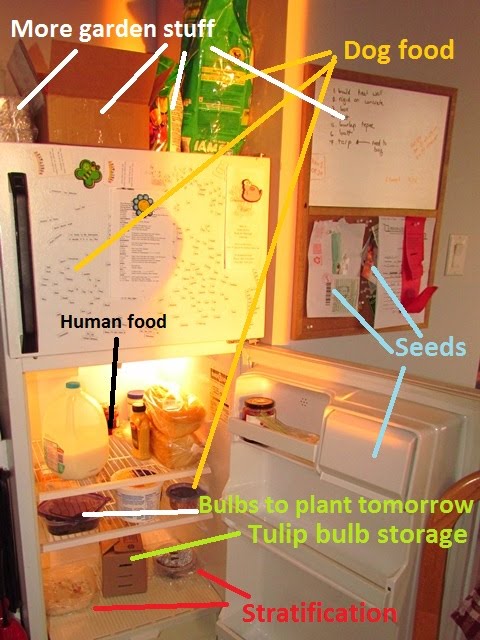
A fridge that contains almost exclusively dog food and garden things. On top of the fridge is more dog food and garden things, and some bird food. On the board are more seeds and notes about the garden. Not shown, to the left of the fridge is a pile of planters and a big bag of composted cow manure; to the right of the fridge are the dog's food dishes; and opposite the fridge is a bigger pile of planters. And the dish drying rack contains several garden tools.

I do use my kitchen for food, though. Sometimes I make toast.

Burlap: not just for prophets anymore

Here's the thing about winter. Mathematically, if you're a plant, winter is a semi-infinite cold reservoir and a semi-infinite heat reservoir, with 4 or 5 feet of snow in between. The cold reservoir is also very dry, whereas the heat reservoir is hopefully saturated with water; thus the snow not only slows down heat transfer but also prevents loss of water from the heat reservoir. And it's very important for frozen roots to be wet. Dry roots are much more damaged by freezing than wet roots.

Now on a windy seventh-floor concrete balcony, winter is a very small, finite heat reservoir surrounded by an infinite cold reservoir, with just a thin layer of plastic over most of the boundary, except at the top, where the two actually come into contact. If I'm lucky I might get 2" of snow from time to time on the balcony, but it blows away easily.

The problem, therefore, which I tackled last Sunday, is to convert a minuscule uninsulated heat reservoir into a semi-infinite, well insulated heat reservoir.

Hmmmmm...


Step 1: build a heat wall. That garbage can contain 98 L of soil, mostly reclaimed from decommissioned planters. And the burlap bags are a handy acquisition from the hardware store. According to the label, you're supposed to fill them with garden debris, and then soak them with water and leave them out in the yard over the winter, and in the spring you'd have compost. This seems unlikely to happen on my balcony, but certainly the garden debris can hold heat. And as it gets colder, I can progressively saturate them with water, which is an excellent insulant and heat reservoir. So here we see the heat wall, interposed between the cold reservoir and where the plants are gonna be.


Step 2: insulate concrete. Concrete is a great heat reservoir and a very poor insulant. In summer it gets very hot and burns plants, in winter it gets very cold and sucks the heat out of them. So here we have 2" of rigid insulation between the concrete and the planters. Notice that the pansies were still very much alive, this being October 23.


Step 3: profit. I mean, plants. Here you can see the Jungle, cleaned up a great deal, Liu Shao-ch'i in the foreground, and if you look carefully, you can find Peng Dehuai sticking up behind the Jungle. All these are saturated with water, of course. The last thing you want, like I just said, is to freeze your plants when they're dry.


Step 4: build a box. One layer of cardboard has very little R-value, but it will give the whole construct a shape in Step 5.


Step 5: batts. Every construction worker's least favourite insulant. I scored these, as I mentioned before, from a hardware store that was closing for renos and was trying to get rid of every last thing on the lot. So they gave me this big "damaged" bag of sound insulation for $10. Except only the outside was damaged; the batts are just fine. If you're going to insulate your garden with batts, though, here are four things to bear in mind.

1) Batts are not heat reservoirs. They slow the flow of heat, but they don't store heat themselves, therefore, they are not altogether a substitute for soil and snow.

2) Don't squish batts. Their insulating value depends to a great extent on the air they contain. If you squish them, they lose their effectiveness.

3) Wear a N-95 mask, available for cheap from your hardware store, while handling batts. If you think the mask is uncomfortable, you're gonna like having fiberglass dust in your throat even less.

4) After handling batts, have a cold shower and don't rub your skin. The fiberglass dust is very itchy. If you wash in hot water, it will open your pores and be even more uncomfortable, and the more you rub, the more you're rubbing it into your skin.


Step 6: make a burlap tepee. I can't guarantee that this step contributes anything to the survival of my plants, but in my opinion, it gives them some breathing room instead of smothering them with batts. Beside, having bits of fiberglass insulation in your flowerbeds is really unsightly; the burlap makes cleanup easier.


Step 7: more batts. Don't let the picture fool you, however. It looks like I'm putting tons of batts on top and few around the containers; in reality the container is the most important thing to insulate. You're trying to protect the roots, not the leaves.


Step 8: tarp. I was hoping to get an insulated tarp, but the hardware store had none, and given the price of the regular ones, I don't think I'd have paid for an insulated one anyway. The tarp of course provides very little R-value, but it has several other functions: 1) as a wind break; 2) to prevent water loss; 3) to absorb heat from the sun; 4) to keep precipitation off the cardboard; 5) to hold the whole thing together; and 6) to make it visually acceptable. Given that this particular tarp is 10' x 14' and my balcony is somewhat less than 5' x 10', you may be wondering how I managed to unfold and apply the tarp. Well, I'm a construction worker. One of the greatest skills of a construction worker is the ability to persevere when things are very awkward. What's much more amazing is that I managed the whole thing without swearing a single time, since it was Sunday and I try not to swear on the Sabbath.


And now the bigger questions. Is this enough? Is it too much? And how do I get back into my apartment?

As to the first and second, we'll find out in April if anything is still alive. And as to the third, again, I'm a construction worker; I can do these things. The point of building this whole contraption right in front of my picture window was to take advantage of the huge heat loss from said window, as well as get as much of the limited winter daylight as possible. But other than making access and egress difficult, it also blocked said limited winter daylight from getting into the apartment, where the dog and the non-hardy plants like to bask in it. So two hours later, though I had already showered and put on my pjs and it was getting dark, I went back out there and relocated the whole thing six feet away, where it's not blocking the window. It can still get some of the heat from both the picture window and the kitchen window, and some small amount of sun. Hopefully that won't be the difference between life and death.

I must say, I'm quite pleased with it so far. Granted I have no idea whether my plants are alive or dead inside, but it gives me the impression of having a live garden out there, it brought some closure to the summer garden season, and it keeps the place much tidier than having a bunch of planters full of dead things scattered all over the balcony.

The next day, it snowed.

Thus ends, therefore, the 2011 Summer Garden. Thanks for joining me, and stay tuned for the admittedly much mellower adventures of the Winter Garden, and the upcoming 2012 Summer Garden.

Saturday, October 22, 2011

Suppliers' success rates

One thing I can do with my garden log is see if some suppliers have an unacceptable rate of failure. That way I wouldn't order from them again. So here is how it went down this year.

1. Veseys

I like them. I had about 14 varieties from them this year. The only one that produced nothing was the Pizzicato poppies, but most poppies failed due to overcrowding in the Jungle, so I don't blame them. A 7% failure rate in the horrid conditions in my garden isn't bad. The English daisies didn't live up to my expectations, but I overcrowded them. The "Pot & Patio mix" asters only produced one colour, which irked me, but again, I didn't give them good conditions. On the other the pansies were absolutely excellent and I'm totally buying them again; and the California bluebells also performed well. For next year I'm getting more English daisies and more asters, and hopefully by treating them better, I'll get better results.

2. Swallowtail

I had 19 varieties from them, of which 3 failed; 16% failure. All three were morning glories, however, and at least one of them I tried before and know it's a slow cultivar. Therefore, it's quite likely that all three simply ran out of time. I am definitely buying all these plants from them again, except their English daisies mix. Not that it wasn't good, I just don't need three English daisy mixes.

3. OSC

Seven varieties; one failed, two underachieved, and one I'm not sure, seeing as several other cultivars would have looked much the same so I don't know which supplier to give the points to. Well, that's not a very good record, but then again, all but one packet went into the Jungle, and one can't really judge a supplier by the Jungle. Nonetheless, I'm not planning to buy anything from them next year. I have better options elsewhere for the hollyhock, marigold and morning glory, and the rest weren't interesting. I only buy OSC on impulse at the hardware store anyway.

4. McKenzie Seeds

18 varieties, 4 failed; 22% failure. This includes the cypress vine and thunbergia vies, the delphiniums, and the "Falling in Love" poppies. I can hardly blame the poppies, since they were in the Jungle and were added very late, and besides, "Falling in Love" is simply not a successful endeavour in this house. Still, this isn't a very good performance. On top of that, most of what I bought from them was stuff I didn't even want, but again, the hardware store carries it, so I get sidetracked. For next year I'm doing the hyacinth bean (Darth Plant), flax, convolvulus and morning glories again, but I'm using other suppliers except for the flax, which I haven't found elsewhere. I may or may not do poppies again, but realistically, considering that I seeded 4000 Flanders poppies and many bloomed and went to seed, I suspect I will have no shortage of poppies for many years to come.

5. Seedrack

That's where I get my baobabs. I've read bad reviews of them online, but really, they sell rare seeds with specialized germination needs, so just because someone can't germinate them, doesn't mean the supplier is at fault. I had no trouble germinating the baobabs. I've received more seeds from them already for next year, and most of them are hard to germinate. Some are even hard to store. I sure hope the black pansies will turn out; for the rest, failure is to be expected.

6. Thompson & Morgan

Now these are the ones I'm displeased with. I had seven varities. One, "Kniola's Black Knight" morning glory, did not flower, but it might have run out of time. The convolvulus mix may or may not have succeeded, since I had the same from McKenzie and can't tell which supplier's seeds sprouted; however, the packet from Thompson & Morgan was packed in 2008, so I was pretty pissed off when I received it. And the worst thing was the "blue" geranium that turned out nowhere near blue, and which allegedly they shipped me again and I never received. The one thing that really turned out was the Flanders poppies, but like I said, I'll never get rid of them now, so I certainly won't be needing to buy more. So for next year, I will only buy a couple of things from them, and only because I don't have another source (yet).


In summary, my top suppliers are Veseys and Swallowtail, then Seedrack for rare seeds, McKenzie and OSC in the middle, and Thompson & Morgan last.

Previously unpublished nemophila


These "Baby Blue Eyes" nemophilas are my favourite. Not only they're the bluest, they're also amazingly long-lasting compared to the "Penny Black" and "Five Spot". They were still wide awake as of this morning, after several days of hard frosts and near-zero temperatures around the clock, and snow. But since they were in the window boxes that I really wanted cleaned up, I uprooted them all.

Anyway, the real point of this photo from September 9 is the white one. For whatever reason, one among the thousands of seeds produced a pure white mutant. Unfortunately I couldn't uproot it to keep it separate for further study and other purposes, since the obligatory stygian overcrowding makes separating one plant from my garden impossible. But just so everyone knows, I had a pure white nemophila in my garden. Neener neener.

Previously unpublished photos

Some of the morning glories I don't think I posted before:


These are from a mix called "Carnival" which is available from several retailers. The three colours flowered in 77, 78 and 83 days and were quite productive. I really like it.


This is "Flying Saucers", again, available from several retailers. I only got one flower out of it, partly because it took 109 days and so didn't flower until September 25, three days before the frost that ended flowering on all my Ipomoea. One interesting thing, whereas morning glory flowers normally live for only one day, this one stayed open for two or three; I didn't keep track, but it certainly lived more than one day.


And this is "Double Sunrise Serenade". It looks like a crappy photo, but that's pretty much what the flowers look like. It's a double morning glory with crinkled petals like this, and honestly, that doesn't look so good. Nonetheless I'm buying more for next year, because I collect morning glories.

So now you know.

Perhaps I should have planned this better

I've mentioned before that the garden is the only aspect of my life that is in any way wild, spontaneous and out of control. I suppose this is good, for a garden. Nonetheless, when I envisioned the Wall of Insanity a year ago, I didn't exactly foresee this:


A huge mass of somewhat poisonous vines on my kitchen floor. Hmmmmm...

In my imagination, I would harvest the seeds off the vines at the end of the season, and then, I'm not sure how I figured that would happen, but somehow the vines would disappear from the balcony railing and I'd have a blank slate for next year.

Hm.

First of all, these things take a long, long time to die, and they don't look pretty doing it. And it's also unclear to me why after weeks of waiting, I suddenly ran out of patience after dark on a freezing Friday night. That's a very dumb time to be going medieval with the pruners, even considering that I don't drink. Luckily, I was at least aware of the stupidity of what I was doing, and therefore very cautious about where the shears were relative to my fingers. So other than the vines, nobody got hurt.

For all that these are supposed to be tropical plants from the jungles of South America, most of them were very much alive when I chopped them, which is too bad because they're much more allergenic alive than dead. Not only did I have an allergic reaction to them, which I expected, so did my dog, which I didn't expect and which made me feel quite bad because she had no part in this whole insanity project, and also I have no allergy medication for her, so she had to just live with it. I'm sorry, puppykins.

Why did I drag all the dead vines into the kitchen anyway? Because I was still after the seeds. So it took about an hour to inspect all the vines for mature seeds, harvest them, and then clean up the mess. And herein I discovered some "traditional knowledge" that I didn't magically inherit from my Neolithic ancestors, namely, that the ability for a huge field of plants to produce seeds that mature all at the same time for ease of harvesting is something we've bred for, not a natural trait of plants in general. So whereas wheat can be all chopped down by a combine, morning glories all bloom and produce their seeds at different rates. Insanity Leader bloomed continuously from March 27 to the end of September, which is quite amazing. Six months of blooms is not usual, especially in a place where winter lasts eight months. On the other hand, Insanity 4 hardly flowered at all, and the cultivar "Flying Saucers" in Insanity 2 bloomed for the first and last time on September 25. After the first frost, mind you. Again, pretty amazing for a tropical plant.

So the result of these variations is that I have a massive amount of seeds from Insanity Leader, which is mostly Feringa / Star of Yelta (I still can't tell them apart) and a mix from McKenzie Seeds which they used to call "Early Call mix" and now just call "mix". It has five colours and I don't mind it, but I don't really need this much of it:


Hmmm... Well, you, the reader, can't get an idea of how many there are from this photo, but my preliminary estimate is that we're looking at tens of thousands. And if I know me at all, I'm pretty sure I will take the time to count them all. Not only that, most of them are probably viable. Scary thought, if you consider that I planted "only" 1100 this year and they completely covered my railing. Tens of thousands could wipe the town of the map. And that reminds me, I still have no idea what to do with those seeds, but one thing is fairly certain, namely, I don't want to plant them. Not just because there are too many, but because as I was saying, the vast majority come from Insanity Leader, not from the many other interesting cultivars I had planted. For example, we can be quite sure none are from "Flying Saucers", and equally certain that there are no "Heavenly Blue", partly because it failed to flower yet again, and partly because its seeds have a distinctive shape and I'd have noticed if I had harvested any.

So now, it's time to make like my Neolithic ancestors and reflect on what I could do better next year. Because yes, the Wall of Insanity is definitely coming back next year, with some modifications.

1. Keep cultivars segragated.

Segregation may be bad for people, but it's good for plants, if you want to know what seeds you're harvesting. So for next year, each cultivar gets its own little container, with one stake on which to grow; no more colonizing the railing and getting all tangled together. Where this will get slightly complicated is when I can only get a cultivar as part of a mix. However, morning glories have the huge advantage of being all left-handed. Or maybe they're all right-handed. I'm pretty sure they're left-handed, but the point is, they all twist the same way, so it's quite easy to unwind them from a support. If they grew in random directions, it would be quite impossible. So if I grow a mix around one stake, when it flowers, I can untwist it, sort out the vines by colour, and re-twist it around individual stakes. Clever, eh?

2. No planting in the shade.

This year, I had put my most valuable cultivars at the sunny end of the wall, being Insanity Leader and Insanity 1, and the least valuable at the shady end, in Insanity 4. Predictably, the sunny end produced abundantly; less predictably, Insanity 4 hardly flowered at all. I thought that being jungle flowers, they'd be fine in part shade, but no, they really want sun. So for next year, everyone goes to the sunny side, where they will also act as a windbreak for my other plants, and as a privacy screen to keep my stalker from looking at me.

3. Less nitrogen.


This was my first Insanity Plant, pictured here on September 26, 2009. Notice it has hardly any leaves. It's also very short and tiny, but more importantly, it has hardly any leaves, and therefore you can see the flowers. This year I fed all my garden religiously with a 10-15-10 fertilizer, with the result that I had massive greenery, and Ipomoea vines growing more than 8' long, but not too many blooms, and mostly hidden in the foliage. So next year, less nitrogen, more potassium.

4. Start way earlier.

This year, I managed to have a Star of Yelta flower in 45 days from seeding. Impressive, but not something you can count on. The Flying Saucers flowered in 109 days, and the moonflowers in 167 days. Some cultivars, such as Heavenly Blue, take a long time to flower. I think I need to allow five months from seeding to flowers, which is to say I ought to start them by April 1 if I want flowers by September, but if I want them ready for the Yards in Bloom judging, I probably need to start them in February. (That being said, I'm not sure I want to enter the Yards in Bloom next year, but more in a later post.)

So these are the Four Commandments of Insanity. Shouldn't be too hard, really, even given my tendency to say one thing and do the very opposite when it comes to the garden.

Meanwhile, I still have no idea what to do with my tens of thousands of seeds.

Thursday, October 20, 2011

Stupid seedless fruit...

My mandarins did not have seeds in them.

I hate fruits with no seeds in them. Creepy little mutants... I don't buy fruit to eat it, I buy it for the seeds. What good is fruit with no seeds? Even the Bible is against seedless fruit.

Bah.

Saturday, October 15, 2011

Foiled again!!!!

Well, the experiment with the sand-perlite-manure mixture was a complete failure. Whereas soil retains too much moisture, this mix retains too little, so all my seeds dried out. That would be my last four apricot seeds, which I had religiously stratified for the whole duration; my remaining baobab seeds; and my lychees. Fortunately, one of the lychees was not yet germinating when I moved them to the sand planter, so now it has a root that looks like it might still be alive. I'm not 100% on that, but it might still be alive. So I moved it to yet another baobab nursery planter, with the new baobab seeds that I recently received from my supplier. This time I'm doing one seed at a time (one from each species, I mean), and the mix is mostly soil with some perlite in it. Perlite improves drainage, so, we shall see.

No chance of more apricots or lychees until next year, though. What a nuisance. I hope that one lychee is still alive, but I'm not optimistic. Also, I was gonna get some catalpa seeds, but my supplier of rare seeds doesn't have them right now, and I can't find them anywhere else online. So if you know anyone who sells catalpa seeds, let me know.

Meanwhile, I brought in the Guerilla Planter, with Deng Xiao Ping, the chief aster, and, as it turns out, four pear trees that have survived being completely ignored all summer. In fact, maybe complete ignorage is better for trees than constant fussing. In any case, all four look wide awake and full of ideas. This poses a problem as to potting. Pear trees make taproots, so I don't doubt those four little trees are down to the bottom of their planter, and I'm going to need (four) tall planters for them. On the other hand, since they have taproots, they're probably not crowding into each other, and therefore repotting is probably not urgent. So maybe I can leave them alone until somewhat later. The bigger issue is that both pears and chokecherries are seasonal trees, which is to say they need a period of dormancy. Deng has shed most of its leaves, as have Liu Shao-ch'i and Peng Dehuai. Those two are staying on the balcony for the winter; Deng and the pears are inside, and the pears are bright green and not looking at all disposed to go to sleep. Will they survive a winter in the house, or will they die from sleep deprivation?

The next day, I also repatriated Planter #9, which contains the last surviving "blue" geranium, still decidedly purple but also very much alive; my oriental lily; and the globe thistles. Again, these are hardy plants, therefore I doubt they'll be happy in the house all winter, but then again, they have disappointed me, so if they die, so be it.

But that's not all! I still have seeds in the fridge! The holly seeds moved from warm stratification to cold stratification on October 10. I also have a bunch of cherry pits that have been stratifying since September 11. According to my sources, cherries are inconsistent in their stratification habits and can start sprouting even before being warmed up; I'm thinking I'm gonna give them six weeks.

Also, I have more seeds stratifying outside! The fun never ends here. I harvested some berries off some shrubs that had nice fall colours. One is cultivated and seems to be intended for a hedge some years from now. I believe it's called Peking cotoneaster. The other grows wild all over town and is possibly a red osier dogwood. Or some other kind of dogwood. I planted both in Planter #17, formerly home of the pumpkins. They'll die, or they'll come up in the spring. Stratifying outdoors worked out perfectly for the chokecherries, so I'm taking the view that anything I harvest out of doors (rather than from fruit bought from the store) can stratify outside.

What else... Faith and Hope are doing very well, thank you. They've been inside September 11 and are both putting on some growth. And I just bought two mandarins today, which hopefully will have some seeds in them. I'm not hungry enough to eat them right now, though. I wonder whether they need stratifying or not. China is pretty cold, but I can't think of any other citrus that needs stratification. I better google it.

That's about it for plants I'm working on right now, really. Out on the balcony, there are a few things still in bloom: poppies, "Baby Blue Eyes" nemophilas, English daisies, bellflowers, which finally bloomed on September 15 and are completely underwhelming, one convolvulus, one dianthus, and pansies. The morning glories still have flower buds on them but have been unable to open for some time now because it's not warm enough. Likewise the marigolds formed buds, to my surprise, as far back as September 11, and have been progressing slowly ever since; I doubt they'll succeed in flowering. Among the morning glories, the following cultivars did not bloom: Heavenly Blue, Kniola's Black Knight, Chocolate, and Blue Star. The thunbergia vine, cypress vine, and Darth Plant also did not flower. I'll be planting Darth Plant again next year, but not thunbergia. Undecided about cypress vine.

Also undecided is what I'm gonna do with the colossal amount of seeds I've harvested off my morning glories. The obvious answer would be "plant them", but with very few exceptions, they're from Insanity Leader, and therefore all varieties I've done several times. For next year, I'm going to get all the same varieties I had this year, and any more I can find, but I'm gonna plant one variety per container, and keep them all straight and orderly; that way I'll know what seeds I have. The current collection of seeds is really of no use to me, so I could either find somewhere inconspicuous to dump them, in which case I suspect they'll run over the town, or throw them in the garbage, in which case they will colonize the dump. Or scatter them at the dump and call it "beautification."

At this time, to be honest, I'd really like to get a nasty frost to kill everything non-hardy, so I can start winterizing. It's not really fun watching plants that aren't doing anything, and if this warm fall gives way suddenly to winter, I'll be out there in nasty weather cleaning up, and I'd rather not do that.

So, now you know.

Tuesday, October 4, 2011

Gardening post-season... pre-season... something

Yes, yes, I've been neglecting this blog. Well, what can you do. Working is such an impediment to doing nothing all day.

That being said, I have photos, which I haven't sorted in weeks, and things that have bloomed, and things that have failed, and other things to tell you about, when I get around to it. But what I did though, I bought some bulbs. I mean other than the good bulbs I ordered from Veseys in August. Speaking of which, they charged my credit card on September 12 and I don't have my bulbs yet. I should email them and see what's happening.

Anyway. So I was at the hardware store to buy some Pine Sol, and to get to the till, I have to walk past the garden section. I assumed this was safe, since gardening is over for the year, so I glanced at the shelves as I walked past.

Hmmmm... That was a mistake.

On the shelves, they had these cute little bags of fall bulbs. An assortment of 60 fall bulbs in matching colours, the dominant colour being indicated by the colour of the gingham pattern on the bag. Very cute. Very dumb way to buy bulbs, but very cute. And also, very cheap. Also a good sign that it's a dumb way to buy bulbs, but what can you do... They were on sale for $14.97. That's about $0.25 a bulb. How bad can it be, really, for $0.25 a bulb? I buy seeds more expensive than that.

Ok, so I bought one bag. Pink. I'm not a pink kind of person, but the pink assortment was the prettiest. Then I put it in the fridge because I had other things to do. But keeping bulbs in a plastic bag is bad, so today I decided to plant half, store the other half the "right" way in the fridge. Of course some people will tell you that you can't keep bulbs in the fridge over the winter, but it's my garden, I do whatever the heck I please.

I opened the bag and immediately I smell mold.

CRAP!!!

Well, what can you expect when you buy a bag of bulbs off a store shelf for $14.97?

In the bag, there were:

8 daffodils "Salome", white and pink - four seemed sound
8 tulips "Angelique" - 7 were sound
14 chionodoxa "pink giant" - 2 were sound
30 alliums "ostrowskianum" - 7 were sound

Hmmmm... To be honest, I'm not sad about the alliums and the chionodoxa, as I don't fancy the former and had never heard of the latter before. But the tulips and the daffodils are really quite pretty in the photo. I hope some of them grow.

Next, planting. As you know, I follow none of the planting instructions, but bulbs are different. I read the planting depth and actually attempted to plant as recommended. Not as to spacing, of course. Overcrowding is the rule in my planters. But I did dig into the Jungle to a depth of about 6", as indicated for my tulips and daffodils, and set the bulbs pointy side up, and then added some manure on top. Now you'd think, the Jungle being already grossly overcrowded, I'd be destroying other plants' roots by doing this, but not really. You see, most of the plants in the middle never even sprouted, so it has a big bald spot, and I ripped up all the daisies weeks ago, so there is room there, and the poppies and other escapees that are leaning through the railing never grew deep roots, either because they're annuals or they weren't getting enough water. Don't matter to me either way. I dug under their roots. In some places I also dug under the hollyhocks, which are perennials and therefore I would like not to kill, but on the other hand, they haven't flowered, so bollocks to them.

After I had replaced the dirt over the daffodils and tulips, I poked holes with my index finger and planted the tiny allium and chionodoxa bulbs in those. Then I added a pile of manure on top. I didn't want to put in any new soil, because the Jungle has the advantage of not being troubled by fungus, whereas some of the other soil may or may not be contaminated. But I needed more cover, and also, I've had the same soil in there for three seasons, so it could use manure.

Then I watered.

Then, we'll have to see in the spring if anything comes up.

For greater certainty, I bought a bag of batt insulation today. One of the hardware stores in town is doing renos and needs every single item of inventory gone from the premises this week, so everything's on sale and their ad said "no reasonable offer refused." I was hoping to make a completely unreasonable offer on a Makita cordless drill, but they had no cordless drills of any brand. They did, however, have quite a lot of batt left, in particular a damaged bag of "acoustic" insulation that they couldn't move and were glad to part with for $10 (down from $35 or so). "Acoustic" isn't noticeably different from "thermal" fiberglass batt, it's just not R-rated. So now I have a nice big bag of insulation for the winter. I also need an insulated tarp and some rope, but that's not urgent. Winter isn't for a month yet.

I do hope my expensive bulbs come from Veseys thought. They were really quite nice bulbs.